Read AI summary
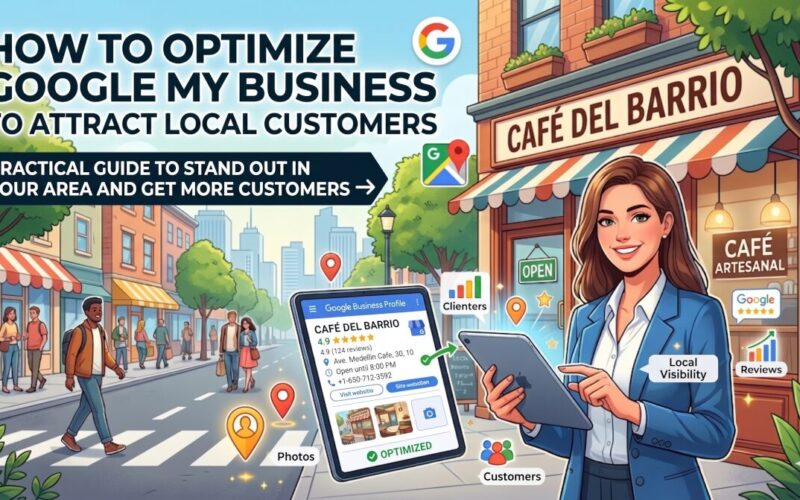
When someone searches for a restaurant, a hardware store, or an accounting firm nearby, the first thing that appears on Google isn’t a website: it’s a listing. That box with a name, address, photos, hours, and reviews is called a Google Business Profile, although most people still know it as Google My Business. And what determines whether that listing shows up among the top results or gets buried on the second page has a name: optimization.
For any business with a physical presence or a geographic service area, local SEO is one of the highest-return channels available. A well-optimized listing can generate calls, visits, and inquiries consistently, with virtually no advertising investment. The problem is that most businesses create their profile, leave it with basic information, and move on. That’s exactly where the difference between appearing and not appearing begins.
In this article, we explain what Google My Business is, why it matters to optimize it, and how to do it in a practical way.

What is Google My Business and how does it work?
Google Business Profile (formerly Google My Business) is a free tool from Google that allows businesses to manage how they appear in Search and on Google Maps. Through it, businesses can publish information such as name, address, phone number, business hours, photos, services, and receive customer reviews.
When someone types “plumber in Palermo” or “bookstore near me,” Google triggers what is known as the local pack: a block with three highlighted listings that appears above the traditional organic results. These listings are not chosen at random. Google selects them based on factors such as the business’s relevance to the search, its distance from the user, and the brand’s online prominence.
The listing also directly influences the purchase decision. A user who sees a profile with updated photos, recent reviews, and clear hours has much more information to act on than someone who finds an incomplete or outdated profile. This evaluation moment happens before the user clicks or makes a call, and what they find in those seconds determines whether the business enters their consideration or not.
👉 What’s better for your site: a domain with or without www? In our latest article, we tell you which option to choose and how to configure it correctly to avoid SEO problems.
Why is it important to optimize your Google My Business listing?
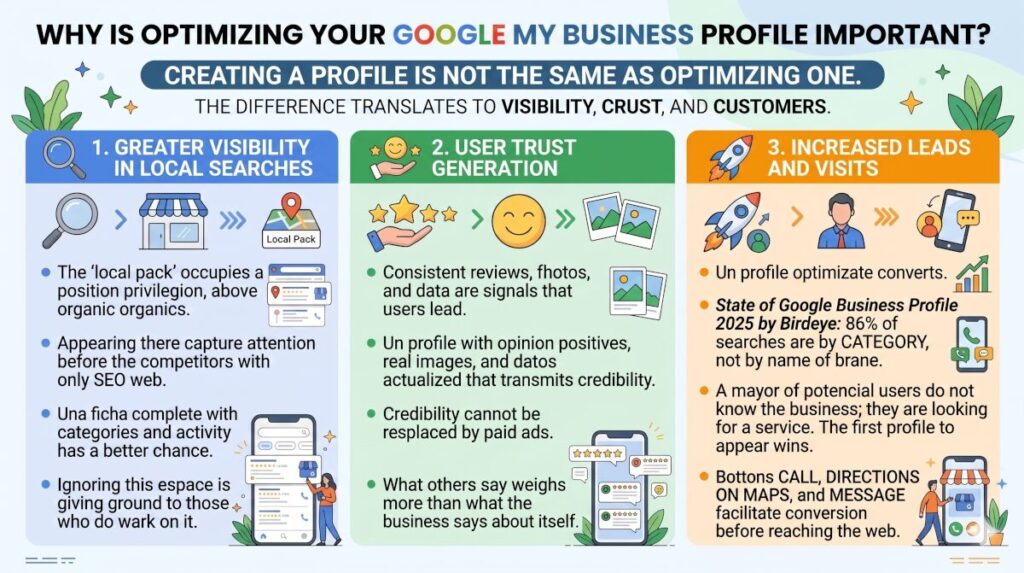
Having a profile created is not the same as having an optimized profile. The difference translates into visibility, trust, and ultimately, customers.
Greater visibility in local searches
The local pack occupies a prime position in search results, above the usual organic listings. Appearing there means capturing the user’s attention before any competitor that has only worked on their website SEO. A listing with complete information, well-chosen categories, and recent activity has a better chance of entering that block. Ignoring that space means giving ground to those who do work on it.
Building trust with users
Reviews, photos, and data consistency are signals that users evaluate before choosing a business. A profile with dozens of positive reviews, real images of the location or team, and up-to-date contact information conveys a level of credibility that no paid ad can replace. What others say about a business carries more weight than what the business says about itself.
Increase in leads and visits
An optimized listing converts. According to the State of Google Business Profile 2025 by Birdeye, 86% of searches on Google Business Profile are made by business category, not by brand name. This means that most users who could reach a business don’t know it yet: they are searching for a type of service, and the profile that appears first, with complete and up-to-date information, is the one that gets the inquiry. The call button, the address linked to Google Maps, and the option to send messages are direct touchpoints that facilitate conversion before the user even reaches the website.
How to optimize Google My Business step by step
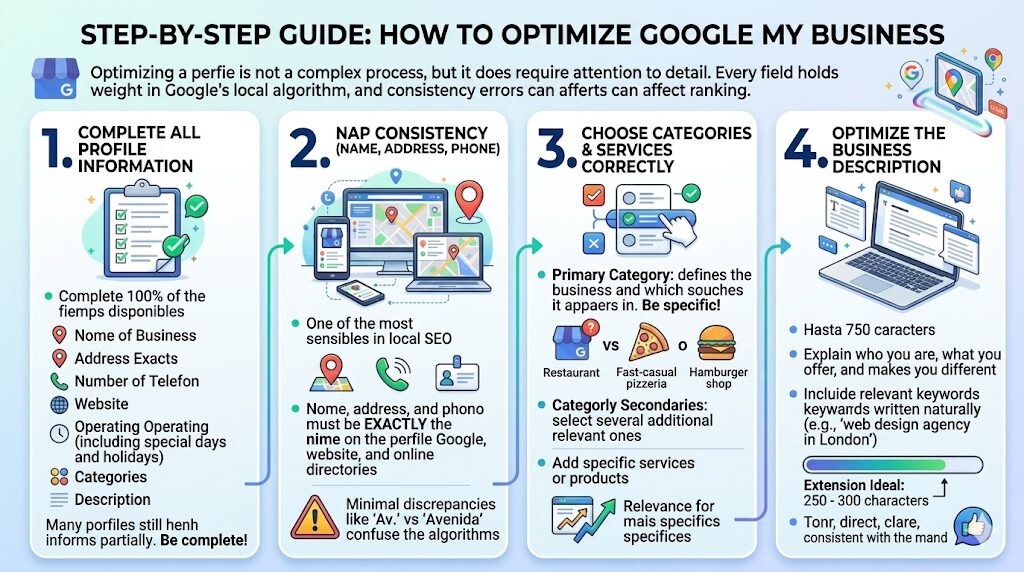
Optimizing a listing is not a complex process, but it does require attention to detail. Each field carries weight in Google’s local algorithm, and consistency errors can affect rankings.
Complete all profile information
The starting point is to complete 100% of the available fields: business name, exact address, phone number, website, business hours (including special days and holidays), categories, and description. It may seem basic, but a significant number of listings on Google still have partial information.
One of the most sensitive factors in local SEO is NAP consistency (Name, Address, Phone). The name, address, and phone number must be exactly the same on the Google profile, the website, and any other online directory where the business is listed. Even a minor discrepancy, like writing “Ave.” in one place and “Avenue” in another, can create conflicting signals for the algorithms.
Choose categories and services correctly
Google allows you to select one primary category and several secondary categories. The primary category is the most important: it defines the type of business Google will associate with the listing and determines which searches it can appear in. Choosing a generic category when a more specific one exists is a common mistake. A “restaurant” that is actually a “takeaway pizzeria” or a “burger joint” should use the category that best describes its specific activity.
In addition to categories, the profile allows you to list the specific services or products the business offers. Completing this section adds relevance for more specific searches and helps Google understand the true scope of the offering.
Optimize the business description
The description is a space of up to 750 characters where the business can explain who it is, what it offers, and what sets it apart. It should include the most relevant keywords for the activity (for example, “web design agency in Buenos Aires” or “dentist in Belgrano”), but written naturally and oriented toward the user, not the algorithm.
The ideal length is around 250 to 300 characters. A description that is too short wastes the space; one that fills characters without providing real information is counterproductive. The tone should be clear, direct, and consistent with the rest of the brand’s communication.
Key elements to optimize your Google My Business listing
Beyond the basic fields, there are actions that make a concrete difference in the listing’s performance.
Review management
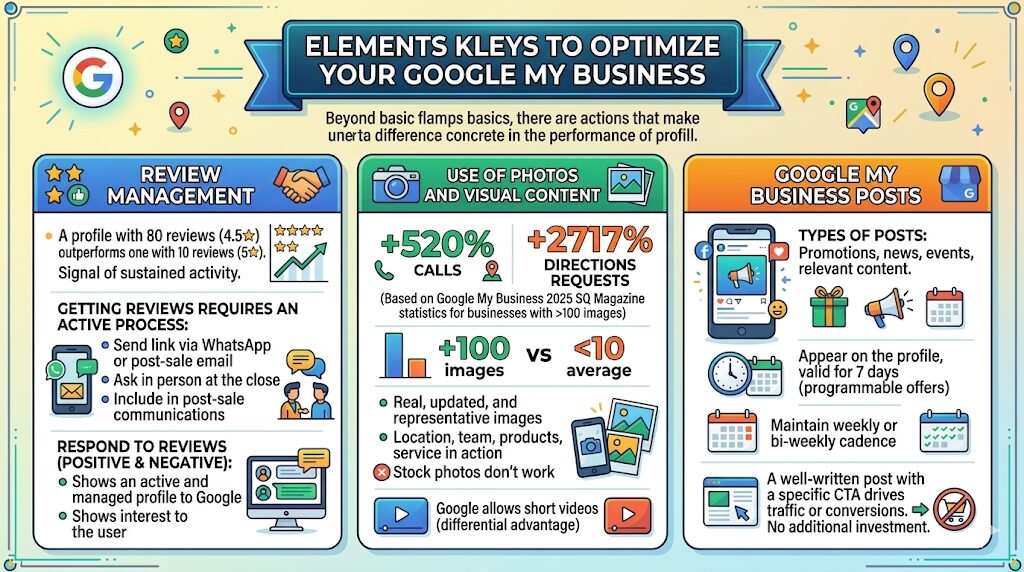
Reviews are one of the most influential factors in local ranking. The quantity, frequency, and average rating directly impact how Google ranks a listing. A profile with 80 reviews and a 4.5 rating will consistently outperform one with 10 reviews and a 5-star rating, because the signal of sustained activity is stronger.
Getting reviews requires an active process: sending the review link via WhatsApp or email after each sale, asking for it in person at the end of a service, or including it in post-sale communications are effective methods. Responding to reviews—both positive and negative—also helps. It shows Google that the listing is active and managed, and shows users that there is someone on the other side willing to listen.
Use of photos and visual content
Photos have a direct impact on a profile’s performance. According to Google My Business 2025 statistics by SQ Magazine, businesses with more than 100 images on their listing receive 520% more calls and 2,717% more direction requests than average. The difference is substantial, yet most profiles have fewer than ten photos uploaded.
Images should be real, up to date, and representative: the location, the team, the products, or the service in action. Stock photos don’t have the same effect. Google also allows short videos to be uploaded, a less-used feature that can be a competitive advantage in sectors where visual content carries significant weight.
Posts on Google My Business
The profile allows you to publish updates similar to a social network: promotions, news, events, or relevant content for customers. These posts appear on the listing and last for seven days (offer posts can be scheduled with specific dates).
Maintaining a weekly or biweekly posting cadence strengthens the activity signal that Google values. A well-written post with a clear call to action can drive traffic to the website or generate conversions directly within the listing, without the need for additional investment.
Factors that influence local ranking
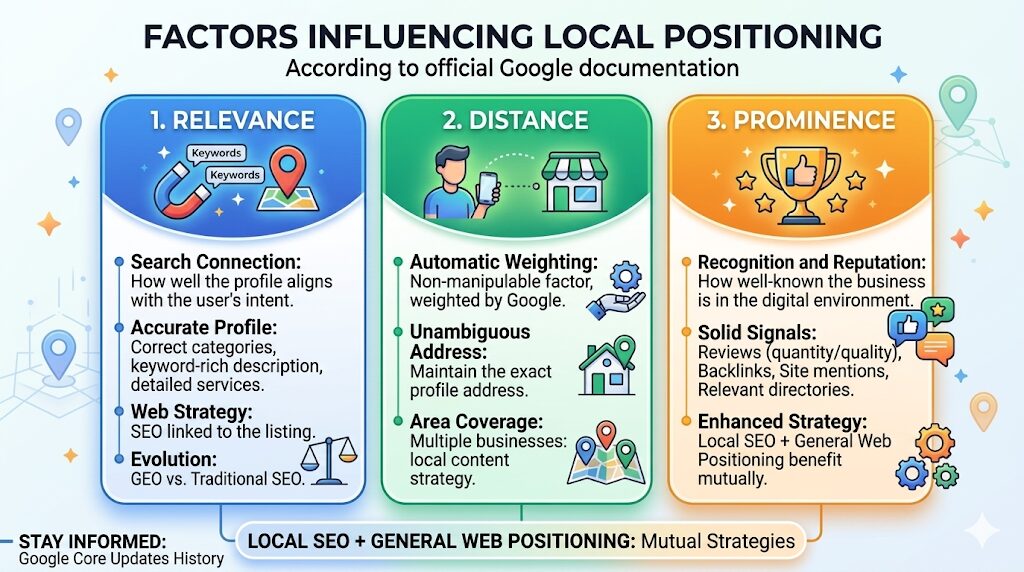
According to Google’s official documentation, local results are primarily determined based on three factors: relevance, distance, and prominence. Understanding how each one works allows you to prioritize optimization actions strategically, rather than working blindly. And since Google frequently updates its algorithms, staying up to date with the history of Google Core Updates is part of any sustainable local strategy.
1. Relevance
Relevance measures how well a business profile matches what the user is searching for. A listing with precise categories, a description with well-chosen keywords, and detailed services has a better chance of appearing in specific searches. Working on a keyword strategy also impacts this factor, especially when there is website content linked to the listing. It’s also worth noting that the rise of GEO over traditional SEO is changing how search engines interpret and prioritize local results.
2. Distance
The distance between the business and the user’s location is a factor that Google evaluates automatically. It can’t be directly manipulated, but it’s essential to keep the profile’s address clear and unambiguous. Businesses that serve multiple areas can complement their listing with a local content strategy to expand their presence in searches across different geographic locations.
3. Prominence
Prominence reflects how well-known and reputable a business is in the digital environment. Reviews, mentions on other sites, backlinks to the website, and presence in relevant directories all play a role. A business with strong online authority can outrank a closer competitor if its prominence signals are more solid. That’s why local SEO and overall website positioning are strategies that reinforce each other.
Conclusions
Google My Business is one of the digital assets with the greatest potential for local businesses. Completing the profile, working on reviews, publishing visual content, and keeping the listing active are actions that generate concrete results: more visibility, more inquiries, and more customers.
The difference between a listing that converts and one that goes unnoticed is rarely the budget. It lies in attention to detail and consistency over time. To know whether these actions are working, it’s key to define and monitor the right SEO KPIs from the start.
If you want to improve your local presence and start attracting more customers through Google, at MD Marketing Digital we can help. We work on local SEO as part of a comprehensive digital strategy, with a focus on measurable results. Contact us and we’ll analyze it together.

- What is query fan out and how it works on Google. - May 22, 2026
- How to optimize Google My Business and attract more customers? - April 30, 2026
- Long-tail keywords: what are they and how can you use them in your SEO strategy? - April 13, 2026
¿Qué te pareció este artículo?
What do you think about this post?