
Read AI summary
Every peso invested in a paid advertising campaign starts to pay off or get wasted long before the first ad is published. PPC keyword research is the step that determines whether your budget will attract real customers or fund clicks that will never convert.
Choosing the right terms allows your ads to appear in front of users with clear purchase intent, while a careless selection fills the report with empty impressions and unjustified costs. In this guide, you’ll find a clear process for doing your keyword research in Google Ads, understanding how many keywords to use, and identifying the most common mistakes to avoid.

What is PPC keyword research?
PPC keyword research is the process of identifying the terms users type into Google when they are looking for a product, service, or solution, in order to use them as triggers for paid ads. Unlike organic work, where the goal is to rank content over time, in PPC each keyword has a direct cost per click. That completely changes the logic behind how they should be chosen.
In an SEO strategy, it may make sense to target broad terms with high volume, even if purchase intent is low. In PPC, that same decision can result in high spending with minimal conversions. Keywords for Google Ads should reflect clear intent: users who are looking to buy, hire, or solve something specific.
Proper segmentation from the start is what allows the budget to go further and ensures that ads reach the people who will actually interact with the offer.
👉 What’s better for your site: a domain with or without www? In our latest article, we tell you which option to choose and how to configure it correctly to avoid SEO problems.
Why is it key in Google Ads?
In Google Ads, keywords determine which searches each ad appears for. If the terms selected are too broad or irrelevant to the business, the system will show the ad to users who are not looking for what is being offered: the cost per click rises and the conversion rate drops.
The impact is direct: well-chosen keywords improve the Quality Score (the quality rating Google assigns to each ad), which reduces the CPC and improves the ad’s position without increasing investment.
An aesthetic clinic that uses the broad term “aesthetics” receives clicks from users looking for makeup courses, beauty products, or information about treatments it does not offer. Spending goes up, but inquiries do not come in. If, instead, it works with terms like “facial dark spot treatment Buenos Aires” or “non-surgical facelift price,” each click comes from someone looking for exactly what the clinic offers, and the cost per conversion drops significantly. That performance difference starts with keyword selection.
How to do keyword research in Google Ads step by step
Good Google Ads keyword research starts with a real understanding of the business and the user. The process that works in practice follows these steps:
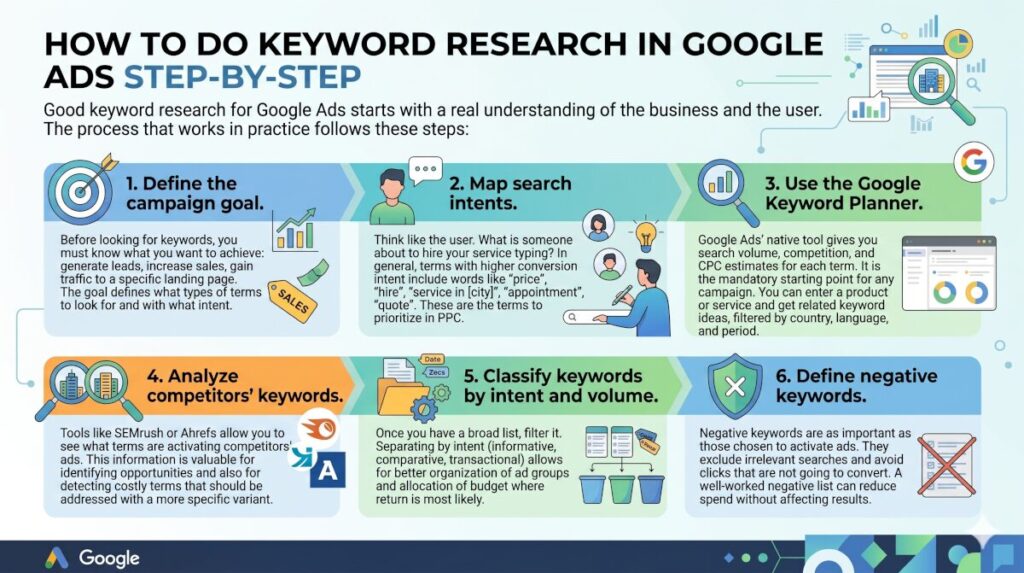
1. Define the campaign objective. Before searching for keywords, you need to know what you want to achieve: generate leads, increase sales, or drive traffic to a specific landing page. The objective defines what type of terms to look for and with what intent.
2. Map search intent. Think like the user. What does someone write when they are about to hire your service? In general, the terms with the highest conversion intent include words like “price,” “hire,” “service in [city],” “appointment,” or “quote.” These are the terms worth prioritizing most in PPC.
3. Use Google Keyword Planner. Google Ads’ native tool gives you search volume, competition, and CPC estimates for each term. It is the mandatory starting point for any campaign. You can enter a product or service and get related keyword ideas, filtered by country, language, and period.
4. Analyze competitor keywords. Tools like SEMrush or Ahrefs allow you to see which terms are triggering competitors’ ads. That information is valuable for identifying opportunities and also for detecting expensive terms that are better approached with a more specific variant.
5. Classify keywords by intent and volume. Once you have a broad list, filter it. Separating them by intent (informational, comparative, transactional) allows you to better organize ad groups and allocate budget where return is most likely.
6. Define negative keywords. Negative keywords are just as important as the ones chosen to trigger ads. They exclude irrelevant searches and prevent clicks that will not convert. A well-developed negative keyword list can reduce spending without affecting results.
To go deeper into how keywords work, you can read our guide on the role of keywords in digital marketing.
How many keywords should you use in Google Ads?
One of the most common questions when building a campaign is how many keywords to add in Google Ads. The short answer: it depends, but less is usually more.
Google recommends working with thematically consistent ad groups, where each one groups terms with similar intent and context. Professional practice indicates that between 10 and 20 keywords per ad group is a reasonable range to maintain control without fragmenting the structure too much.
Adding hundreds of keywords to a single group is one of the most common mistakes. When the terms are too different from one another, ad relevance drops, Quality Score goes down, and CPC rises. The quality of the selection always matters more than the quantity.
Common mistakes when choosing keywords
These are the most common issues that appear when reviewing Google Ads campaigns:
- Choosing keywords that are too broad. Generic terms like “marketing” or “clothing” have volume, but they also attract searches that have nothing to do with the business. The result is high spending with low conversions.
- Not setting up negative keywords. Without a negative keyword list, ads can appear for completely irrelevant searches. For example, a B2B software company could be paying for clicks from students looking for free tutorials.
- Ignoring search intent. There are high-volume terms that only generate informational traffic. If the goal of the campaign is to convert, targeting these types of keywords is a waste of budget.
- Not reviewing or optimizing. A Google Ads campaign is not a set-it-and-forget-it task. Keywords that work well today may stop working the following month. Reviewing the search terms report periodically is part of the job.
If you want to better understand how the entire advertising ecosystem works before going deeper into keywords, our article on what Google Ads is and what it is used for is a good starting point.
Tools for finding keywords in Google Ads
PPC specialists usually combine several tools depending on the stage of the work, since none of them covers the entire process on its own. These are the most commonly used:
- Google Keyword Planner. The main reference for any campaign. It offers search volume, competition, seasonality, and CPC estimate data. It is free with an active Google Ads account and the first place to start any PPC keyword research.
- SEMrush. One of the most complete platforms on the market for competitive analysis. It allows you to see which terms are triggering competitors’ ads, with volume, CPC, and trend data by country. It has a paid plan with limited free features.
- Ahrefs. Its keyword module provides useful context for deciding how aggressive it makes sense to be with certain terms in PPC, especially for understanding ranking difficulty and the intent behind each search.
- Google Trends. Complements volume analysis with seasonality and trend data. Useful for anticipating demand changes and detecting growing terms before they become more expensive in the auction.
- SpyFu. Specialized in historical competitor campaign analysis. It allows you to see which keywords a domain paid for over time and how much it was estimated to invest in each one.
To see how these tools fit into a broader advertising strategy, you can review our article on performance marketing.
Frequently asked questions about PPC keywords
What is the difference between keywords for SEO and PPC?
In SEO, the goal is to rank content organically over time, so it may make sense to work with broad or informational terms. In PPC, each click has a direct cost, so the selection should target users with clear purchase or hiring intent. The evaluation logic changes: in PPC, return per click matters more than search volume.
How many keywords should I use in each Google Ads ad group?
Professional practice recommends working with between 10 and 20 keywords per ad group. Grouping too many unrelated terms lowers ad relevance, reduces Quality Score, and ends up increasing the cost per click. More keywords do not mean better results: what matters is thematic consistency within each group.
What are negative keywords and why are they important?
Negative keywords are terms that are expressly excluded from a campaign to prevent ads from appearing in irrelevant searches. For example, a company that sells professional software can add “free” or “course” as negative keywords to avoid paying for clicks from users looking for free versions or tutorials. A well-developed negative keyword list reduces spending without affecting results.
Which tool should you use to find keywords in Google Ads?
The starting point is always Google Keyword Planner, which is free and native to the platform. For competitive analysis, SEMrush and Ahrefs are the most complete options. Google Trends is useful for understanding seasonality, and SpyFu helps you see which terms competitors have historically used in their paid campaigns.
How do I know if my keywords are working?
The main metric to monitor is the search terms report within Google Ads, which shows exactly what users typed before clicking on the ad. If irrelevant searches appear, they should be added as negatives. If certain terms generate clicks but no conversions, it is worth pausing them or adjusting the bid. Optimization is ongoing: a well-structured campaign requires regular review to remain profitable.
Conclusions
Well-executed PPC keyword research is the foundation of any profitable Google Ads campaign. It determines who the ad reaches, how much each click costs, and, ultimately, whether the advertising investment generates real return. Google remains the dominant search engine with 89.62% of the global market (StatCounter, March 2026), making the platform the essential playing field for any paid advertising strategy.
The process requires analysis, judgment, and constant adjustment. Keywords that perform well today can become expensive or irrelevant tomorrow, which is why optimization is part of the work from day one. For those managing their own campaigns, the starting point is a focused and well-segmented selection, with negative keywords from the beginning and regular review of the search terms report.
For those looking for faster and more efficient results, at MD we work with you from keyword strategy to ongoing campaign optimization. Learn about our Google Ads services and start making every peso invested work better.

- PPC keyword research in Google Ads - May 15, 2026
- What is CTR, CPC, and CPA in Digital Marketing?: A Complete Explanation - October 28, 2024
¿Qué te pareció este artículo?
What do you think about this post?