
Read AI summary
When someone types “sneakers” into Google, they’re probably just browsing. When they type “women’s waterproof running shoes size 38 Buenos Aires,” they’re about to buy. That seemingly small difference defines much of what makes modern SEO work: the value is not always in the most searched keywords, but in the most specific ones.
Long-tail keywords are one of the most underestimated assets in any SEO strategy. They generate less individual traffic than generic keywords, yes, but the traffic they attract has a much more clearly defined search intent. And when it comes to turning visits into customers, that makes all the difference.
In this guide, we’re going to break down what they are, why they matter, how to find them, and how to use them strategically within your content plan.

What are long-tail keywords?
Long-tail keywords are longer, more specific search phrases than generic keywords or head terms. The concept was popularized by Chris Anderson in his book The Long Tail (2006), and it was quickly adopted by the SEO world to describe that universe of low-volume but highly precise searches.
A generic keyword like “digital marketing” may have millions of monthly searches. A long-tail keyword like “digital marketing for small businesses in Argentina” will have far fewer, but the person typing it knows exactly what they are looking for.
There are three characteristics that define long-tail keywords:
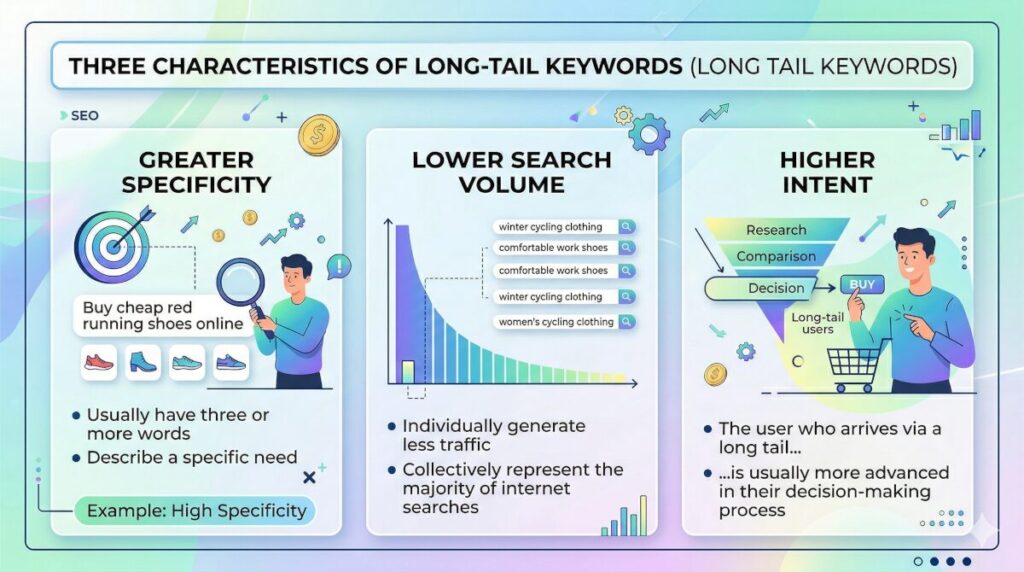
- Greater specificity: they usually have three or more words and describe a specific need.
- Lower search volume: individually they generate less traffic, but together they represent the majority of searches on the internet.
- Higher intent: users who arrive through a long-tail keyword are usually further along in their decision-making process.
According to an analysis by Backlinko of more than 306 million keywords, 91.8% of all search queries correspond to long-tail keywords. That is the long tail in its full extent: a massive universe of opportunities that most brands ignore while chasing high-volume terms.
👉 Want to understand what Query Fan-Out is and why it’s changing the way Google interprets searches? Read our latest article and discover how it’s impacting modern SEO strategies.
Why are long-tail keywords key in SEO?
Long-tail-focused SEO offers clear strategic benefits, especially for sites that are just beginning to build authority or that operate in competitive niches.
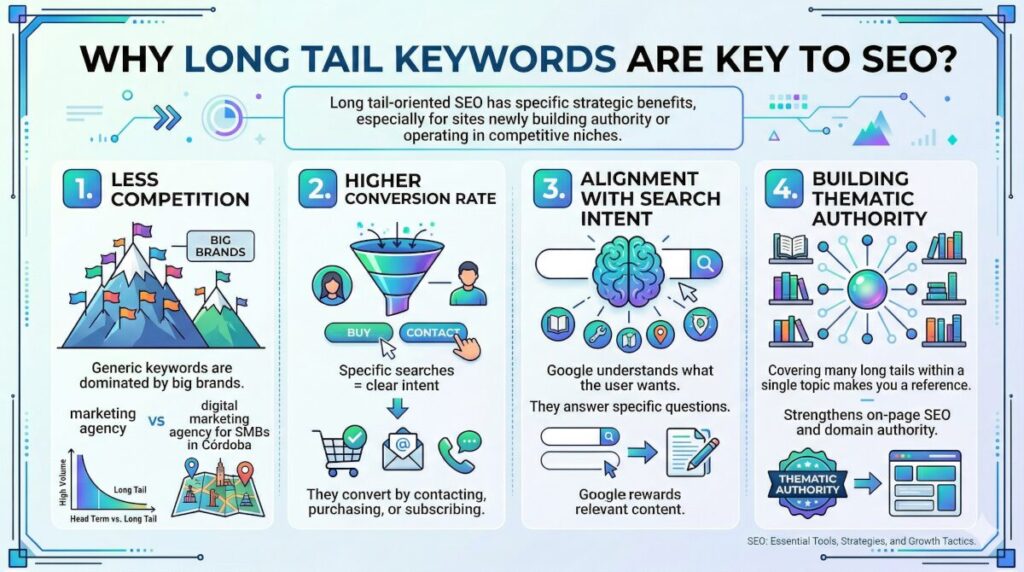
- Lower competition. Generic keywords are usually dominated by large brands with years of accumulated authority. Ranking for “marketing agency” is a long battle. Ranking for “digital marketing agency for small businesses in Córdoba” is much more achievable.
- Higher conversion rate. A user searching for something specific has a clear intent. If your content answers that search exactly, the chances of conversion—whether by contacting you, making a purchase, or subscribing—are considerably higher than with generic traffic.
- Alignment with search intent. Google has spent years improving its ability to understand what the user really wants. Long-tail keywords, by their descriptive nature, align better with that intent. Content built around a long-tail keyword answers a specific question, and Google rewards that.
- Topical authority building. By covering many long-tail keywords within the same topic, a site begins to be perceived as a reference source in that field. That strengthens on-page SEO and contributes to the domain’s overall authority.
How do you choose long-tail keywords?
Identifying the right long-tail keywords requires an organized process. It is not enough to guess what your audience is searching for; nowadays, it is necessary to verify it with data.
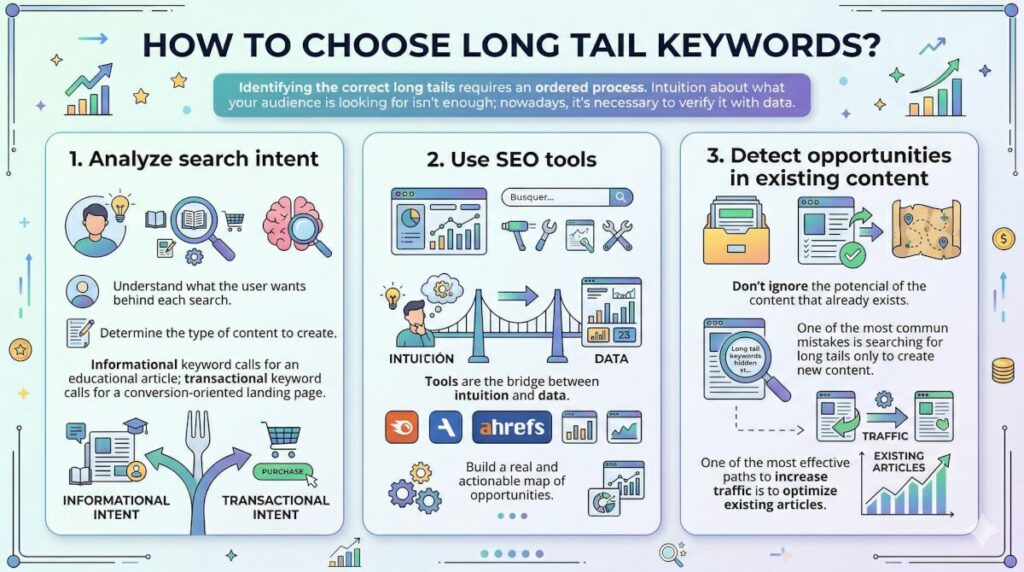
- Analyze search intent
The first step is to understand what the user wants behind each search. In SEO, there are four types of intent:
- Informational: the user wants to learn something. Example: “what is local SEO.”
- Navigational: they are looking for a specific brand or website. Example: “MD Marketing Digital blog.”
- Transactional: they want to buy or hire. Example: “hire an SEO agency in Buenos Aires.”
- Commercial/investigative: they are evaluating options before making a decision. Example: “best SEO tools for small businesses.”
Knowing which type of intent a long-tail keyword responds to is essential for determining what kind of content to create. An informational keyword calls for an educational article; a transactional one, a conversion-focused landing page.
- Use SEO tools
Tools are the bridge between intuition and data. Some of the most useful ones for finding long-tail keywords are:
- Google Keyword Planner: free and straightforward. It allows you to explore keyword variations with search volume and competition data.
- Ahrefs: one of the most comprehensive tools on the market. Its keyword explorer shows related long-tail keywords, their ranking difficulty (KD), and potential traffic.
- Google Search Console: often overlooked, but it is a goldmine. It shows exactly which real queries users are already using to reach your site, making it possible to detect long-tail keywords that are already generating impressions and optimize them.
- AnswerThePublic: ideal for finding frequently asked questions related to a topic. Very useful for structuring informational content.
Combining these tools allows you to build a realistic and actionable opportunity map.
- Identify opportunities in existing content
One of the most common mistakes is looking for long-tail keywords only to create new content, while ignoring the potential of the content you already have. Google Search Console makes it possible to identify articles that are generating impressions but have a low CTR: that usually indicates that the content does not fully match search intent, or that it could be expanded with more precise long-tail keywords.
The process is simple: review the articles ranking on pages 2 and 3 of Google, analyze which queries they are being found for, and optimize those pieces by incorporating the identified long-tail keywords. In many cases, an adjustment to the H1, subheadings, or a few paragraphs can be enough to move an article from the second page to the first.
Examples of long-tail keywords in action
Theory is easier to understand with concrete examples. Let’s look at how it applies in different business contexts.
Ecommerce example
A footwear ecommerce site might try to rank for “sneakers.” It is a keyword with huge volume, but also with brutal competition dominated by major brands and marketplaces. The room for maneuver for a mid-sized business is practically nonexistent.
By contrast, working with long-tail keywords such as “women’s waterproof running shoes,” “men’s trail shoes size 44,” or “running shoes for orthotic insoles” opens up a completely different space. The user searching for those phrases has already decided what type of product they want: the site’s job is simply to be there with the right answer.
Services example
A digital marketing agency operating in Argentina may struggle to rank globally for terms like “digital marketing agency.” However, “digital marketing agency in Buenos Aires for small businesses” is a search with very clear intent: the user is looking for a local provider for a specific type of company. That level of precision reduces competition and exponentially increases the likelihood that someone arriving through that keyword is a real fit for the service.
The same applies to “SEO consulting for ecommerce in Argentina” or “social media agency for restaurants in CABA.” The more specific the search, the more qualified the lead.
Blog content example
For a marketing blog, “content marketing” is a huge and highly competitive topic. By contrast, structuring an article around “how to do content marketing for a dental clinic” or “content strategy for online stores with a low budget” makes it possible to create highly specific pieces that answer concrete questions.
This approach also aligns with content marketing as a discipline: instead of trying to cover everything, it focuses on exactly what a particular segment of the audience is searching for. That generates more relevant traffic and readers who are more likely to come back.
How do you use long-tail keywords in your strategy?
Identifying long-tail keywords is only the first step. The real work lies in integrating them organically into a coherent content strategy.
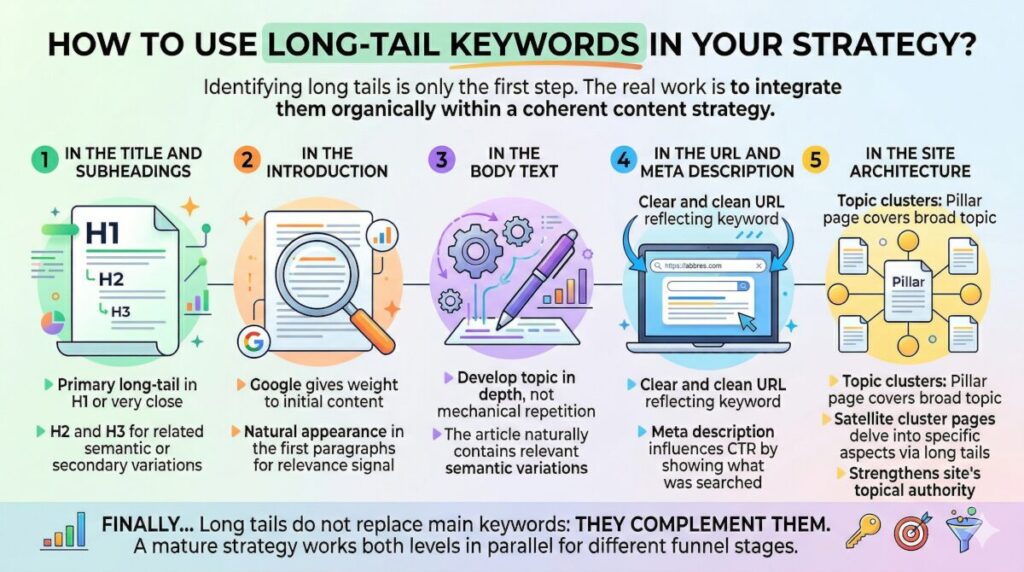
- In the title and subheadings. The article’s main long-tail keyword should appear in the H1 or very close to it. H2s and H3s can incorporate semantic variations or related secondary long-tail keywords.
- In the introduction. Google gives special weight to the content of the first paragraphs. If the long-tail keyword appears naturally in the intro, the relevance signal is stronger.
- In the body text. It is not about repeating the keyword mechanically, but about developing the topic in depth. An article that responds well to a long-tail keyword will naturally include relevant semantic variations.
- In the URL and meta description. The URL should reflect the main keyword clearly and cleanly. The meta description, although not a direct ranking factor, influences CTR: if the user sees exactly what they searched for in the snippet, they are more likely to click.
- In the site architecture. Long-tail keywords also help design a content structure based on topical clusters: a pillar page covers the topic in broad terms, and satellite pages go deeper into specific aspects through long-tail keywords. This architecture strengthens the site’s topical authority in Google’s eyes.
Finally, it is important to understand that long-tail keywords do not replace primary keywords: they complement them. A mature strategy works on both levels in parallel, with different goals depending on the stage of the conversion funnel the user is in.
Conclusions
Long-tail keywords are, in many ways, the backbone of an SEO strategy focused on real results. They make it possible to compete in spaces where budget matters less than precision, attract users with clearly defined search intent, and build topical authority in a sustained way.
Ignoring them in favor of high-volume keywords is a common mistake, especially for businesses that are just starting to work on their organic presence. Traffic volume is a vanity metric if it is not accompanied by conversions—and long-tail keywords are, in most cases, what generate that converting traffic.
If you want to develop an SEO strategy based on real data, with keyword research aligned to your business goals, at MD Marketing Digital we can help. Our team works with a strategic, results-driven approach, from research to implementation. Contact us and let’s start building your organic presence with purpose.

- What is query fan out and how it works on Google. - May 22, 2026
- How to optimize Google My Business and attract more customers? - April 30, 2026
- Long-tail keywords: what are they and how can you use them in your SEO strategy? - April 13, 2026
¿Qué te pareció este artículo?
What do you think about this post?