

Read AI summary
Google search has changed. For years, the logic was simple: you write a query, the search engine returns a list of results. That model worked for decades and was the foundation on which the entire SEO industry was built. But with the arrival of AI Mode and the expansion of AI Overviews, Google incorporated a technique that fundamentally transforms how a search query is interpreted: query fan out.
Instead of processing a single search, the system breaks it down into multiple subqueries executed in parallel, builds a more complete and contextual answer with them, and delivers it to the user without them having to do anything else. For those working on web positioning, this has direct consequences on how to create content, how to structure a website, and how to think about an SEO strategy.
In this article we explain what query fan out is, how it operates internally, and what it means for digital marketing.

What is query fan out?
Query fan out is an information retrieval technique through which Google breaks down an original search into multiple related subqueries. Each one targets a different angle of the user’s intent, and all are executed simultaneously to gather more diverse and complete information.
The result of that process is what the user sees as a response in AI Mode: a synthesis that integrates sources, perspectives, and data extracted from multiple searches that occurred behind the scenes. Google described it this way in the official announcement of AI Mode during Google I/O 2026: the system breaks down the question into subtopics and launches multiple queries simultaneously on behalf of the user, which allows it to explore web content with a depth that traditional search cannot achieve.
The technique was publicly presented by Elizabeth Reid, head of Search at Google, who described it as the central mechanism that makes the level of intelligence of AI Mode possible.
👉 What’s better for your site: a domain with or without www? In our latest article, we tell you which option to choose and how to configure it correctly to avoid SEO problems.
Difference between traditional search and query fan-out
In traditional search, the process is linear: a query goes in, a list of results comes out. If the user wants more information or needs to explore another angle, they have to launch a new search manually.
Query fan-out works differently. When someone types a question in AI Mode, the model identifies the subintentions behind that query and generates multiple searches on related subtopics, all simultaneously.
A concrete example: if someone searches for “best wireless headphones for home office“, traditional search returns results for that exact phrase. Query fan-out, on the other hand, can generate subqueries like “noise-canceling headphones for remote work“, “microphone quality in bluetooth headphones” or “battery life in over-ear headphones“, to build an answer that anticipates what the user probably needed to know, even if they didn’t ask for it explicitly.
How query fan out works in AI Mode?
When the user submits a query in AI Mode, Google’s systems analyze the query with advanced natural language processing to evaluate the intent, complexity level, and whether it’s appropriate to activate fan-out. Simple queries, like “capital of Spain“, do not extensively activate the mechanism. Open or multifaceted queries deploy it fully.
The process follows these stages:
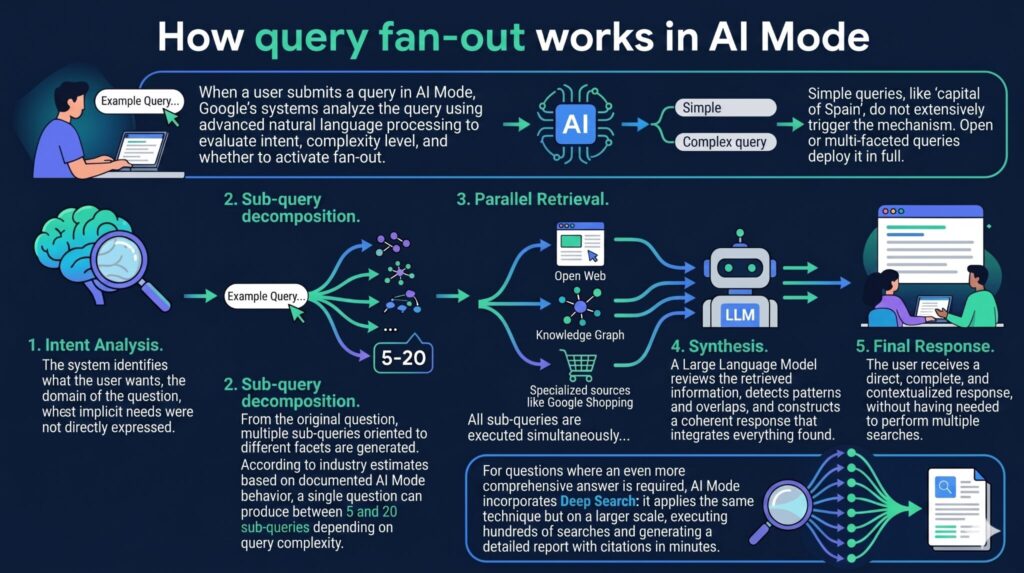
1. Intent analysis. The system identifies what the user wants, what domain the question belongs to, and what implicit needs were not directly expressed.
2. Decomposition into subqueries. From the original question, multiple subqueries are generated aimed at different facets. According to industry estimates based on documented AI Mode behavior, a single question can produce between 5 and 20 subqueries depending on the complexity of the query.
3. Parallel retrieval. All subqueries are executed simultaneously, querying the open web, the knowledge graph, and specialized sources like Google Shopping.
4. Synthesis. A large language model reviews the retrieved information, detects patterns and overlaps, and constructs a coherent response that integrates everything found.
5. Final response. The user receives a direct, complete, and contextualized answer, without having needed to perform multiple searches.
For questions that require an even more exhaustive response, AI Mode incorporates Deep Search: it applies the same technique but on a larger scale, executing hundreds of searches and generating a detailed report with citations in minutes.
How query fan out affects SEO?
The impact of query fan out on web positioning is concrete. An analysis by Surfer SEO (December 2025) on 173,902 URLs and 10,000 keywords found that 67.82% of pages cited in AI Overviews were not in the top 10 organic results, neither for the main query nor for any subquery. The system does not reward whoever ranks first in the SERP, but the content that better responds to the subtopics it generates behind the scenes.
Is it the end of SEO based solely on keywords?
Optimizing exclusively for an exact keyword loses weight in an environment where the system evaluates your page against a set of subqueries, not against a single phrase. The AI Mode response is the result of a synthesis: if your content covers the main intent well but ignores related angles, it falls outside the reach of fan-out.
Keywords are still relevant, but the weight shifts toward semantic coverage. To understand how they work and how to use them within a strategy, our article on keywords in digital marketing is a good starting point.
Importance of semantic and in-depth content
For a page to be retrieved in multiple fan-out subqueries, it has to cover the topic with real breadth. Pages that address several angles of the intent are much more likely to appear cited in AI responses than those that limit themselves to answering a single question.
In practice, this means content that not only defines a concept, but also contextualizes it, compares it with alternatives, analyzes it in different scenarios, and anticipates the questions that naturally arise from it. In our article on content marketing we develop a concrete framework for tackling that.
Structured and scannable content
AI needs to identify, extract, and reuse information efficiently. Content with clear H1, H2, and H3 headings, specific paragraphs, and well-defined sections facilitates that process. Each section has to be able to function relatively autonomously: if the system retrieves only that fragment to answer a subquery, the information has to be complete and useful on its own.
Structure, in this context, is also a visibility factor: well-organized content enters more easily into the pool of sources that fan-out can retrieve.
How to optimize content for query fan out
Cover all search intents
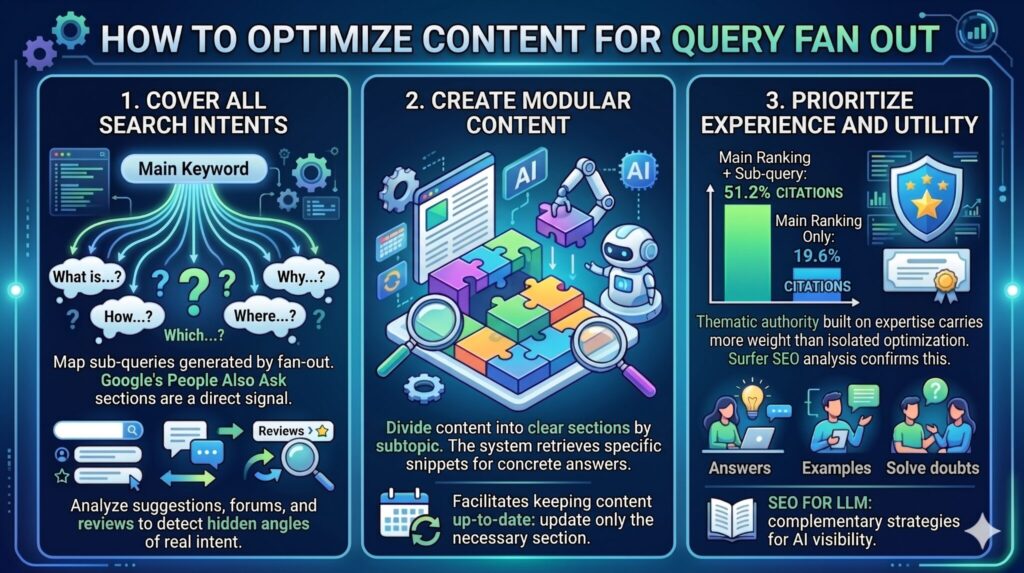
The first step is to map the subqueries that fan-out can generate from your main keyword. The People Also Ask sections in Google are a direct signal: they show the related questions that users ask around a topic.
It also helps to analyze search suggestions, specialized forums, and reviews to detect angles that don’t emerge obviously but are part of the real intent behind a query.
Create modular content
Dividing content into clear sections, each focused on a specific subtopic, is one of the most direct strategies to improve visibility in AI search. Modular content makes it easier for the system to retrieve specific fragments and use them to answer concrete subqueries, without needing to process the entire article.
Additionally, this structure makes it much easier to keep content updated: when data changes or new information emerges about a subtopic, you update that section without touching the rest.
Prioritize experience and utility
The same Surfer SEO analysis showed that ranking for the main query and at least one subquery represents 51.2% of citations in AI Overviews, while ranking only for the main query drops to 19.6%. Thematic authority built on an area of expertise weighs more than isolated optimization for a keyword, and the numbers confirm it.
Content has to resolve real doubts, include concrete examples, and avoid vagueness. For those working on positioning with a focus on AI visibility, our article on SEO for LLM develops complementary strategies that go in the same direction.
Frequently asked questions about query fan out
Does query fan out affect all types of searches equally?
No. Google activates the mechanism more intensely in complex or multifaceted queries. Simple and straightforward searches, like basic definitions or specific data points, can be processed without triggering extensive fan-out. The more open and intentional the question, the more subqueries the system generates.
Is ranking in the top 10 enough to appear in AI Mode responses?
Not necessarily. According to the Surfer SEO analysis (December 2025), 67.82% of pages cited in AI Overviews were not in the top 10 organic results. What determines visibility is that the content answers the subqueries that the system generates well, regardless of the position for the main query.
How do I identify the subqueries that Google can generate for my keyword?
There are several available signals: the questions in the People Also Ask block, related search suggestions, semantic analysis of content already ranking in the top positions, and tools that simulate the fan-out process. It’s also useful to observe what subtopics are developed in depth by the best-positioned articles in your niche.
Does query fan out replace traditional SEO?
It doesn’t replace it, it expands it. Authority signals, technical site quality, and content architecture remain relevant. What changes is that SEO oriented solely at ranking for an exact phrase is no longer enough. Semantic coverage and thematic depth become decisive for appearing in AI search.
Does query fan out work the same way in AI Overviews and AI Mode?
Not exactly. AI Overviews uses a lighter version of the mechanism, oriented toward answering informational queries quickly. AI Mode applies fan-out more aggressively, especially in complex questions that require synthesis from multiple sources. And Deep Search, the most advanced function of AI Mode, can execute hundreds of searches for a single query.
Conclusions
Query fan out is a concrete change in how Google processes and responds to searches. The system no longer evaluates whether a page matches a keyword: it evaluates whether that content can answer multiple angles of a complex intent. For web positioning strategies, this means moving away from the logic of “ranking for a phrase” and starting to think about thematic coverage, depth, and structure.
Adapting to this scenario requires strategic judgment and a perspective that goes beyond classic technical optimization. In our team we work SEO as part of an integrated strategy and we help companies and brands build real digital presence in an environment that changes quickly. If you want to know how to apply all this to your site, we can help you.

- What is query fan out and how it works on Google. - May 22, 2026
- How to optimize Google My Business and attract more customers? - April 30, 2026
- Long-tail keywords: what are they and how can you use them in your SEO strategy? - April 13, 2026
¿Qué te pareció este artículo?
What do you think about this post?