
Read AI summary
SEO KPIs are indicators that help determine whether a positioning strategy is working. It’s not just about measuring traffic. The goal is to understand whether that traffic brings real value to the business. That’s why choosing the right SEO KPIs is key to connecting optimization efforts with concrete results.
In this article, you’ll find a clear and practical guide to understand what to measure, why to measure it, and how to use that information to make better decisions.

Defining what SEO KPIs are and their strategic function
A KPI (Key Performance Indicator) is a metric that shows whether an action is delivering the expected results. In SEO, KPIs help evaluate the impact of content, the site structure, the user experience, and the domain authority, among other things.
Their function is simple: to measure performance and provide reliable information to adjust the strategy. Without this data, it’s hard to know what’s working and what isn’t. Even worse: there’s a risk of investing time in tasks that don’t add value to the business.
👉 Want to learn the best digital marketing strategies for real estate agencies? Read our latest blog post!
How to choose SEO KPIs according to your goals
Not all businesses need the same SEO KPIs. Each site has different goals. Some aim for more traffic. Others need qualified leads. Some depend on direct conversions.
That’s why KPI selection depends on the stage of the funnel, the business model, and the type of content you want to rank. Before measuring, it’s a good idea to answer three questions:
- What do I want to achieve with SEO?
- Which indicators show that progress?
- What is the starting point?
With that foundation, it’s easier to choose meaningful metrics instead of measuring just for the sake of it.
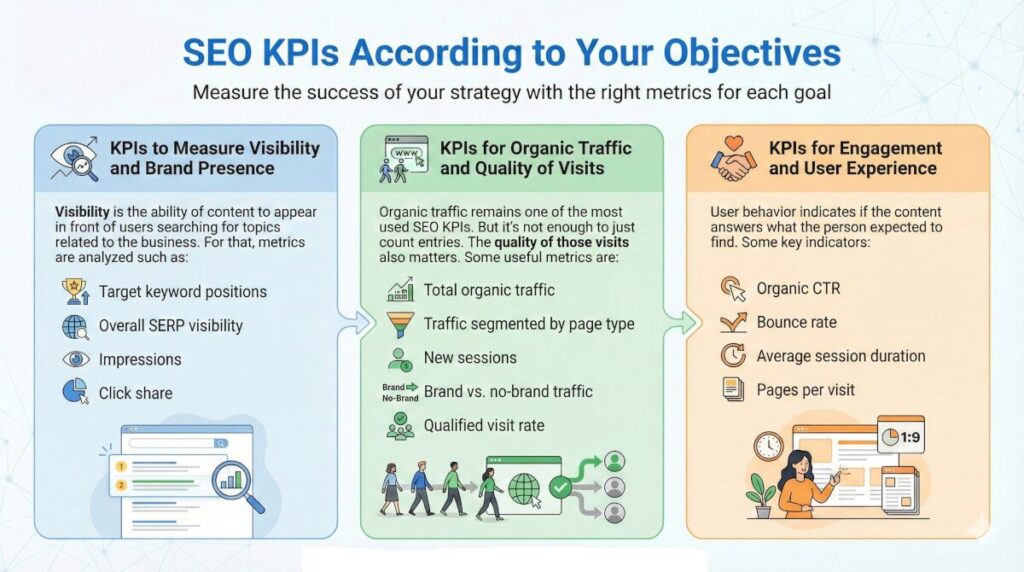
KPIs to measure visibility and brand presence
Visibility is the content’s ability to appear in front of users searching for topics related to the business. To measure this, metrics such as the following are analyzed:
- Rankings of target keywords.
- Overall visibility in the SERP.
- Impressions.
- Click share.
These data points show whether Google is finding, indexing, and displaying the content. If impressions increase and rankings improve, it’s a positive sign. If visibility drops, it’s time to review the content quality or the competition in that niche.
Organic traffic and visit quality KPIs
Organic traffic remains one of the most commonly used SEO KPIs. But it’s not enough to simply count visits. The quality of those visits also matters.
Some useful metrics include:
- Total organic traffic.
- Traffic segmented by page type.
- New sessions.
- Branded vs. non-branded traffic.
- Qualified visit rate.
When traffic grows but doesn’t generate interaction or sales, something is out of sync. Measuring properly helps determine whether you’re attracting the right people or if you need to adjust the content’s search intent.
Engagement and user experience KPIs
User behavior indicates whether the content delivers what the person expected to find. Some key indicators include:
- Organic CTR.
- Bounce rate.
- Average session duration.
- Pages per visit.
If these metrics are low, there may be issues with relevance, design, or site speed. If they perform well, it’s a sign that the content provides value and holds the user’s attention.
Conversion metrics that connect SEO with business results
For many companies, this is the most important part. Conversion metrics show whether SEO not only brings visits but also real opportunities. This includes indicators such as:
- Organic conversions.
- Qualified leads.
- Sales generated from organic traffic.
- Average value per visitor.
These metrics help determine whether the traffic coming in is the right kind. If the site gains rankings and traffic, but conversions don’t increase, something isn’t working. It could be the search intent, the messaging, the design, or the conversion process.
On the other hand, when an improvement in content or structure leads to more leads or sales, the KPI reflects it immediately. And that data helps decide where to focus time, budget, and effort.
Measuring conversions isn’t just about performance control. It’s a way to connect the work of the SEO agency with concrete business objectives and demonstrate its impact on business growth.
Technical and site health KPIs you can’t ignore
Technical performance underpins all SEO efforts. When the site is not in good condition, content loses reach.
The most important technical KPIs are:
- Core Web Vitals.
- Load speed.
- Crawl errors.
- Indexed pages.
- Quality backlinks.
These metrics help identify issues that affect user experience. If the site is slow, hard to crawl, or full of errors, Google will show it less. And that impacts all other metrics.
Measuring authority and off-page signals
Site authority depends on external factors. Good content isn’t enough. It also matters how other sites and users interact with the brand. Some KPIs to measure this include:
- Domain authority.
- Quantity and quality of backlinks.
- Links from media or relevant websites.
- Brand mentions without links.
This data helps understand how the digital ecosystem perceives the brand. A domain with strong authority and trustworthy links tends to rank better and maintain positions over time.
SEO KPIs in 2026: what’s changing with AI and new search formats
The way people search is changing. Generative AI and direct answers are reshaping how Google displays results. This is driving an evolution in SEO KPIs.
Some trends for 2026 include:
- Visibility metrics in AI-generated responses.
- Citations and references in LLMs.
- Zero-click interactions.
- Data on actual user intent.
- Content reach in AI-integrated search engines.
It’s no longer enough to measure clicks. The new search experience blends traditional results with conversational answers. That’s why we need indicators that show how a brand appears in these generative spaces, even when users don’t click.
Conclusions and next steps to boost your SEO
SEO KPIs help you determine whether your strategy is heading in the right direction. They’re essential for understanding visibility, traffic, visit quality, conversions, and the technical health of your site. They also allow you to make data-driven decisions instead of relying on assumptions.
If you want to improve your strategy, the first step is to define what to measure. The second is to analyze that data regularly. And the third is to adjust your actions based on what the indicators show.
A solid measurement system can organize your workflow, prevent mistakes, and demonstrate real results. And if you need help designing or interpreting these KPIs, you can always seek professional support from MD Marketing Digital.

- SEO KPIs: what they are and why they matter for your business - January 26, 2026
- What is performance marketing and how does it work? - August 22, 2025
- What is a URL with /feed/? - July 1, 2025
¿Qué te pareció este artículo?
What do you think about this post?