
Read AI summary
Advertising automation has moved forward at full speed, and Performance Max has already become the standard within Google Ads.
Today, any business needs to leave behind manual management of isolated channels and take advantage of Google’s entire inventory under a single intelligent strategy, designed 100% to generate conversions. And to improve the results of your paid media and scale your digital performance, it helps a great deal to work with a specialized Google Ads agency.
Here we explain what these automated campaigns are, how they work, and which best practices you can apply to get more out of your advertising investment. Keep reading!

What Is Performance Max and How Does It Work in the Google Ads Ecosystem?

Performance Max (PMax) is a goal-based campaign type that uses Google’s automation and machine learning to optimize performance in real time. Unlike traditional campaigns, PMax centralizes all of the brand’s advertising management in a single unified structure. This centralization completely transforms the way advertisers manage their accounts and budgets:
- Unified management: you manage all placements and ad formats from a single central campaign.
- Real-time optimization: the system adjusts bids and placements second by second based on the actual likelihood of conversion.
- Goal-driven approach: you set clear business goals (such as conversions or conversion value) to properly guide the algorithm.
Main Components and Channels Where the Ads Are Shown
One of the great advantages of this format is access to Google’s entire inventory network from a single campaign.
Ads are distributed dynamically across multiple key platforms in the ecosystem:
| Channel / Platform | Ad Type and Focus |
| YouTube | Video ads adapted to the platform’s mass, fast-paced consumption. |
| Display Network | Visual impact across millions of websites that belong to the network. |
| Search Network | Capturing direct intent from users with high commercial interest. |
| Google Discover | Personalized recommendations based on the user’s interests and habits. |
| Gmail | Sponsored messages delivered directly to the target audience’s inbox. |
| Google Maps | Local promotion aimed at attracting customers to brick-and-mortar businesses. |
The algorithm intelligently decides where and when to show each creative asset based on search intent and the user’s previous behavior.
Audience Signals: The Key to Guiding Google’s Algorithm
No matter how automated the tool is, Performance Max does not work “blindly” as long as it is given the right direction from the start. That is exactly what audience signals are for: they provide the algorithm with first-party data, such as current customer lists, databases of previous buyers, or prior interactions with the brand.
With those signals, the campaign shortens its learning curve and the system focuses on the profiles that truly add value to your business.
Step by Step: How to Optimize Performance Max Campaigns to Improve Conversions
To keep the budget from being spread thin and achieve an optimal Return on Ad Spend (ROAS), it is essential to apply good periodic maintenance practices. Some key recommendations include:
- Asset review: periodically review the asset performance reports (Asset Report) to discard low-impact creatives and boost the ones that convert best.
- Strategic exclusions: add brand exclusions and IP exclusions to protect your traffic and avoid impressions on irrelevant placements.
- Feed optimization: constantly update and enrich your product feeds in Google Merchant Center if your strategy is e-commerce oriented.
- Conversion setup: correctly and rigorously configure value-based conversions to feed the algorithm with accurate, reliable data. Audit your analytics and conversion performance, and review the marketing attribution models you use.
Keeping a weekly review routine and not leaving campaigns on autopilot makes it possible to detect deviations in time, adjust the strategy according to market behavior, and ensure that every dollar invested in Google Ads translates into sustainable growth for the business.
Common Mistakes to Avoid When Setting Up Your PMax Campaigns
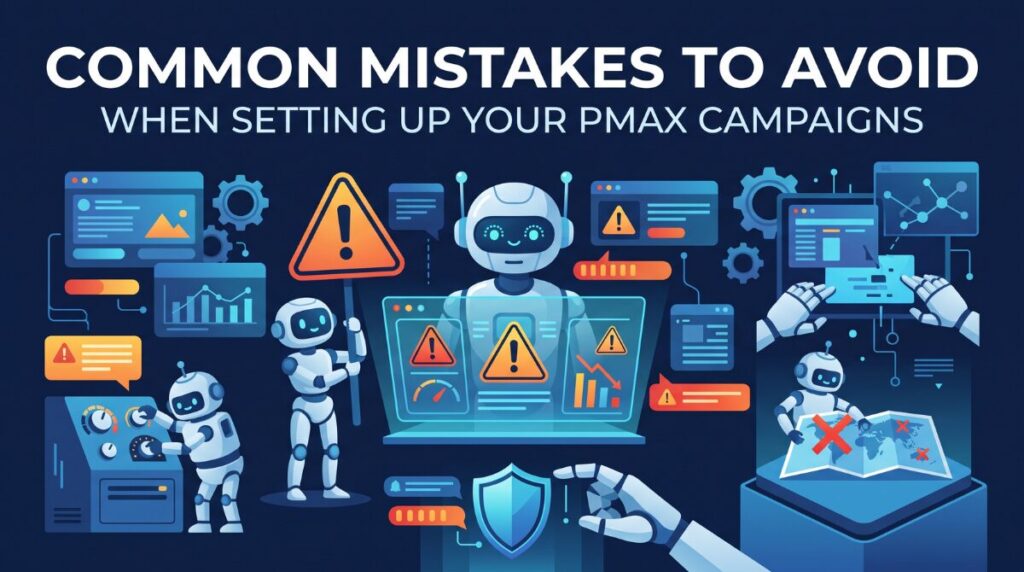
Managing Performance Max campaigns requires strategy and method. One wrong move can send costs soaring and reduce performance.
One of the most frequent mistakes is leaving the campaign running in a fully “automatic” mode without constant monitoring of conversions, which tends to steer traffic toward the wrong goals.
Another common mistake is constantly changing budgets or making mass changes to creative assets; this interrupts and drastically alters the algorithm’s learning phase, restarting Google’s optimization processes.
Another critical error is failing to properly configure geographic location exclusions or inappropriate-content exclusions, exposing the brand to impressions on sites or in regions that add no commercial value and do not protect corporate reputation.
Avoiding these operational failures and keeping strict control over the main parameters ensures that the advertising investment stays protected, allowing automation to work efficiently toward the business’s commercial goals.
Maximize the Return on Your Campaigns with MD Marketing Digital
A Performance Max strategy works when it is fed good data and monitored closely and consistently.
At MD Marketing Digital we support companies in boosting the performance of their advertising investments, with personalized strategies fine-tuned to the max.
Get in touch through our website so we can review your Google Ads campaigns together and take the next step toward your company’s growth.

- Performance Max: What It Is and How to Optimize Campaigns in Google Ads - October 20, 2026
- How to Appear in AI Overviews: GEO Keys to Gain Visibility on Google - October 13, 2026
- Programmatic SEO: What It Is, How It Works, and When to Implement It - October 2, 2026
¿Qué te pareció este artículo?
What do you think about this post?