
Read AI summary
Repeating your keyword ten times in an article no longer guarantees anything. Google stopped reading text word by word a long time ago: now it interprets what your content is about, what problem it solves, and whether it answers what that person searched for better than the rest. We call this approach to content semantic SEO, and if you’re still building your articles thinking only about stuffing in an exact keyword, you’re falling behind.

What Is Semantic SEO?
Semantic SEO is the way of optimizing content by focusing on the full topic and search intent, rather than on an isolated keyword. Instead of focusing on how many times “semantic SEO” appears in a text, it analyzes what the person who made that search needs to find, what questions they have around that subject, and what related concepts (entities) should be present for the content to be complete.
Working with entities means identifying the people, places, concepts, and terms that Google associates with your topic. If your article talks about content marketing but never mentions concepts like strategy, audience, or channels, the search engine will likely interpret that your coverage is incomplete, even if the main keyword appears multiple times.
👉 Want to know what programmatic SEO is and how it helps scale your site? Find out in our latest blog post.
How Is It Different from Traditional SEO?
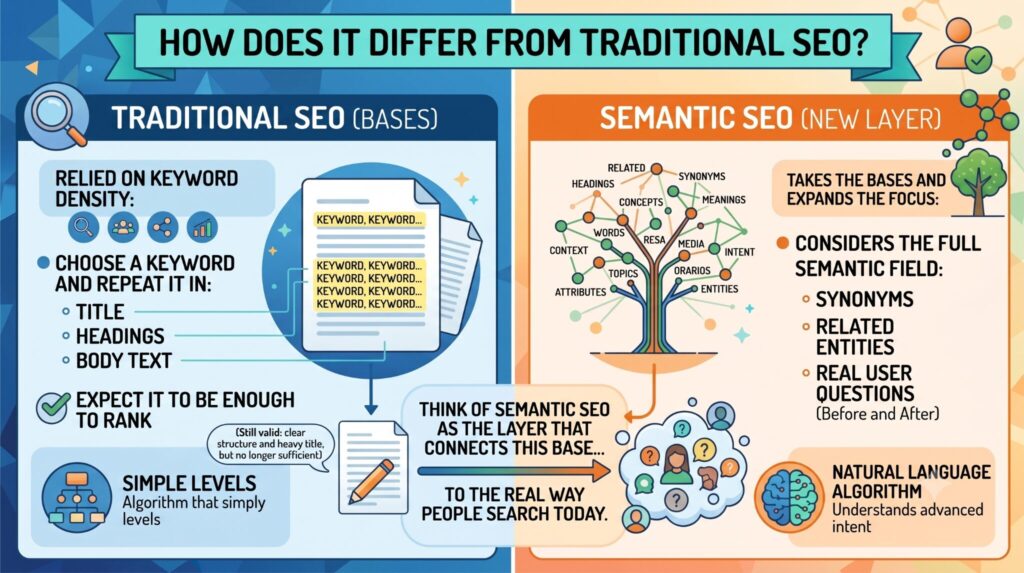
The SEO that most people learned first relied on keyword density: choosing a keyword, repeating it in the title, headings, and body text, and hoping that would be enough to rank. That foundation is still valid (a well-crafted title and a clear structure still carry weight), but it stops being enough when the algorithm understands natural language.
Semantic SEO takes that foundation and broadens the focus: beyond the exact keyword, it considers the complete semantic field of the topic, including its synonyms, its entities, and the questions a real user asks before and after searching for it.
If you’re already clear on what SEO is and what it’s for, think of semantic SEO as the layer that connects that foundation with the real way people search today.
What Is Semantic SEO For?
Working with a semantic approach has a direct effect on how your content ranks. An article that covers a topic in depth, with its related concepts, has a better chance of also showing up in searches you didn’t even have in mind when writing it. This strengthens your site’s topical authority: Google starts associating your domain with that topic and gives more weight to future related content.
It also directly improves the experience of whoever reads you. If your article answers the main question and also addresses the doubts that come up around it, the person doesn’t have to go back and search somewhere else. This matters even more with the rise of conversational searches and engines like Google AI Mode, ChatGPT, or Perplexity, which no longer return a list of links but instead provide an assembled answer drawn from multiple sources. If your content isn’t structured so these tools can understand what it’s about, they simply won’t cite you.
How to Apply Semantic SEO Before Writing
The work of semantic SEO starts in the research phase, before writing a single line. That’s when you should look at your main keyword and ask yourself what’s behind that search: who’s doing it, at what point, and with what goal.
Next comes reviewing what frequently asked questions come up around the subject (Google shows them directly in “People Also Ask”), identifying the entities and concepts that your top-ranking competitors include and you still don’t, and grouping all of that into subtopics your article can cover without becoming endless.
This stage is also the time to think about the role that article plays within your site. If you’re not yet clear on what keywords are and what role they play in your strategy, it’s worth reviewing before building your content plan, because a good part of the topic map you’ll need to cover comes from there.
The same goes if you’re building a full content marketing strategy: semantic SEO works best when each article has a defined role within a larger plan, not as a standalone piece.
How to Optimize Your Website with Semantic SEO?
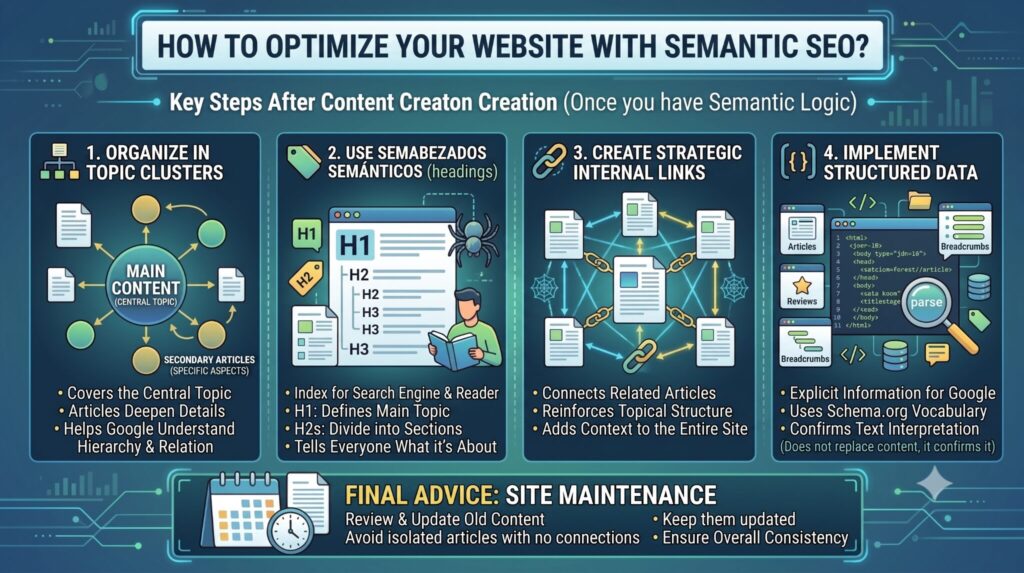
Once the content is written with that logic, the next step is site structure. Organizing articles into topic clusters (a main piece of content covering the central topic and several secondary articles that dive deeper into specific aspects) helps Google understand the hierarchy and the relationship between your pages.
Headings also play a semantic role: a well-planned H1 and a series of H2s work almost like a table of contents that tells both the search engine and the reader what each section is about. On top of that, internal links come into play: connecting related articles to each other reinforces that topical structure and gives each page more context about the site as a whole.
Another piece that adds value here is structured data, which gives Google explicit information about a page’s content using the Schema.org vocabulary. It doesn’t replace the content work, but it helps the search engine confirm what it has already interpreted from the text.
Finally, reviewing and updating old content is part of the job. An article that’s been left isolated, with no connection to the rest of the site and not updated in a long time, takes away from the overall consistency, even if it’s individually well written.
Common Mistakes When Working with Semantic SEO
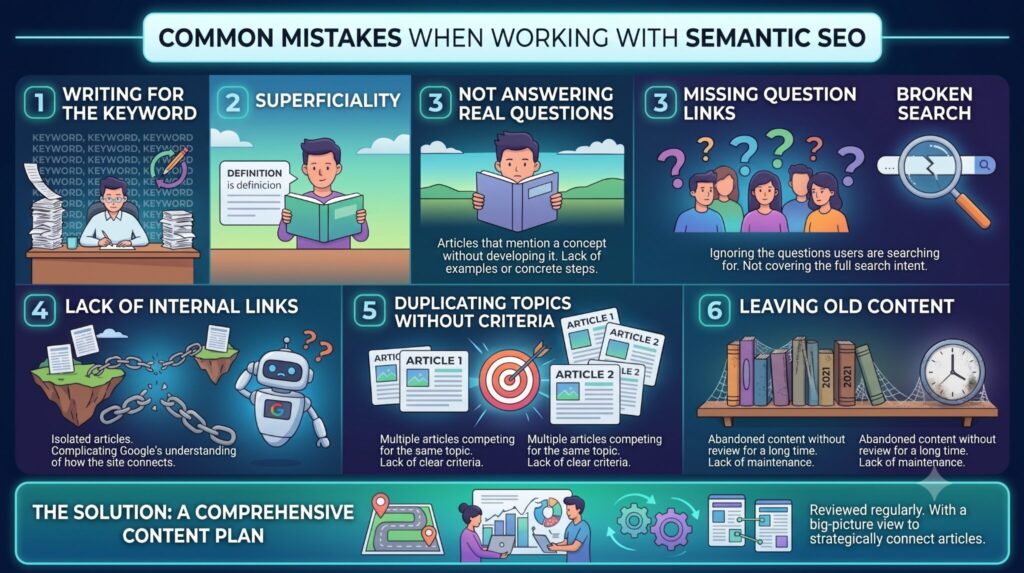
The most frequent mistake is still writing for the keyword instead of writing for the person: stuffing the keyword into every paragraph without adding new information creates repetitive content that doesn’t go deep into anything.
Another common problem is superficiality: articles that mention a concept without developing it, that stay at the basic definition and don’t get into examples or concrete steps.
It’s also common to not answer the users’ real questions. If your article never touches on the doubts people actually search for around the topic, no matter how well written it is, it won’t cover the full search intent.
On top of that, not linking related content leaves each article isolated and makes it harder for Google to understand how it connects with the rest of your site.
Duplicating topics without a clear criterion, with multiple articles competing for the same thing, and leaving old content without review are two habits worth cutting.
At the core, almost all of these mistakes are avoided with the same thing: a content plan that’s reviewed regularly and takes into account how articles connect with each other.
Frequently Asked Questions
Does semantic SEO replace traditional SEO?
No, it complements it: you still need a clear title, an organized structure, and a well-chosen keyword, but on top of that you add topical depth and related entities.
Do you need special tools to apply it?
It’s not mandatory, although keyword research and competitor analysis tools help identify which entities and subtopics you’re leaving out.
How long does it take to see results?
As with any content strategy, results show up in the medium term, especially when semantic work is applied consistently across several articles connected to each other, not just one.
Take Semantic SEO to Your Content Strategy
Applying semantic SEO doesn’t mean rewriting your entire site overnight. Start by reviewing your best-performing articles, identify what questions and entities they’re missing, and plan your upcoming content around clusters instead of standalone pieces.
If you need help building that plan, at MD Marketing Digital we work on SEO strategy comprehensively: from topic and entity research to site structure and content production. Learn more about our SEO service and tell us what stage your site is at.

- Programmatic SEO: What It Is, How It Works, and When to Implement It - October 2, 2026
- International SEO: How to Rank a Website in Different Countries and Languages? - September 25, 2026
- Crawl budget: what it is and how to optimize the crawling of a website - September 18, 2026
¿Qué te pareció este artículo?
What do you think about this post?