
Read AI summary
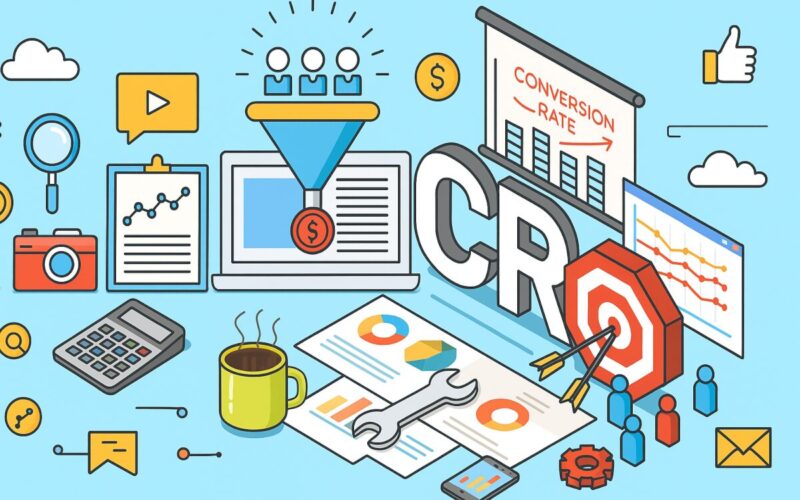
When we talk about CRO marketing, we refer to the acronym for Conversion Rate Optimization. In simple terms, CRO is the set of techniques, strategies, and tools aimed at increasing the percentage of website visitors who perform a desired action: purchasing a product, completing a form, subscribing to a newsletter, or downloading a resource.
Now, understanding what CRO is in marketing means distinguishing it from other areas. While digital marketing focuses on attracting traffic and generating business opportunities, CRO aims to make the most of that traffic. On the other hand, when we talk about CRO in web design, we refer to the optimization of the user experience from a visual and structural standpoint: button design, element layout, usability. Both approaches are connected, but the first focuses on business results and the second on browsing experience.

Importance of CRO in a digital marketing strategy
In any digital strategy, attracting visits is only the first part of the journey. The real challenge is converting those visits into customers. That’s where digital marketing CRO comes into play.
A digital sales funnel combines multiple channels: SEO, SEM, social media campaigns, email marketing, or inbound marketing. All of them generate traffic, but without a conversion rate optimization strategy, that effort can be wasted. Optimizing conversion means reducing customer acquisition costs, improving return on investment (ROI), and increasing sales with the same amount of traffic.
Let’s consider an example: an e-commerce site with 10,000 monthly visits and a 1% conversion rate achieves 100 sales. If it improves small aspects like the clarity of its call to action (CTA) or the checkout process and increases its conversion to 2%, it will double its sales to 200 without needing to attract more traffic.
👉 Want to understand what Query Fan-Out is and why it’s changing the way Google interprets searches? Read our latest article and discover how it’s impacting modern SEO strategies.
Benefits of applying CRO in your business
Applying conversion rate optimization in your business goes far beyond simply getting more sales. The benefits are numerous and extend across your entire digital operation:
- Increase in conversions and sales: This is the most obvious and direct benefit. By optimizing the user experience, more visitors will complete the desired action, resulting in a tangible increase in your business goals.
- Better user experience (UX): CRO is based on understanding and meeting your users’ needs. By removing friction and making the process more intuitive and enjoyable, you’re improving the overall experience, which builds trust and loyalty.
- Resource optimization: By converting more with the same traffic, your advertising and marketing investment becomes more efficient. You’re getting the most out of every dollar spent on attracting visitors.
- Data for decision-making: The CRO process is inherently data-driven. Every test and analysis provides valuable information about your users’ behavior, allowing you to make informed and strategic decisions for your business’s future.
It’s important to note that CRO in digital marketing is a discipline applicable to all businesses, not just large companies. A small or local business with an online presence can also benefit greatly from implementing CRO strategies to optimize their contact forms, service bookings, or local product sales.
How CRO works in digital marketing
The CRO process isn’t magic, it’s methodology. It’s a continuous improvement cycle that can be summarized in four key phases: analysis, hypothesis, testing, and improvement.
Identifying improvement opportunities
The first step for any conversion rate optimization strategy is understanding where the “bottlenecks” or friction points are in the user experience. This involves a deep analysis of the customer journey, from the moment the user lands on your site to when they complete the conversion. Where do they get stuck? What pages do they visit before leaving? What elements do they ignore?
To do this, various tools and techniques are used:
- Quantitative data analysis: Google Analytics (or alternatives) is essential for understanding overall behavior: bounce rate, time on page, navigation paths, exit points.
- Qualitative data analysis: Heatmaps (to see where users click and scroll), session recordings (to watch real-time interaction), user surveys, and interviews to understand their motivations and frustrations.
- Competitor analysis: What are your competitors doing? What design or persuasion elements are they using?
Implement changes and test
Once improvement opportunities are identified, hypotheses for improvement are formulated. For example: “If we simplify the contact form from 10 to 5 fields, the conversion rate will increase because it will reduce perceived effort.”
This is where A/B and multivariate tests come into play:
- A/B test: The original version (A) is compared with a modified version (B) of a page or element to see which performs better. For example, two versions of a “Buy” button with different texts.
- Multivariate test: Multiple variations of several elements are tested simultaneously to identify the most effective combinations.
These tests allow you to validate or refute your hypotheses with real data, avoiding changes based on assumptions.
Measure results and optimize
After a testing period, it’s crucial to measure the results based on key metrics:
- Conversion rate: The percentage of visitors who completed the desired action.
- CTR (Click-Through Rate): The percentage of clicks on a specific element.
- Time on page: How long users stay on a page.
- Bounce rate: The percentage of users who leave the site after viewing only one page.
If the hypothesis is validated and the modified version performs better, it’s implemented permanently. If not, the experiment provides learnings, the hypothesis is adjusted, and testing resumes. CRO in digital marketing is an ongoing, iterative process—there’s no final point, there’s always something that can be improved.
Practical CRO strategies in digital marketing
Now that we know what CRO is in marketing, let’s look at some concrete tactics you can apply to optimize your conversion rate:
- Optimize your CTAs (Calls to Action): Buttons and links that invite users to take action are crucial. Make sure they are clear, visible, attractive, and that their text creates urgency or highlights a benefit. For example, instead of a boring “Submit,” try “I want my offer” or “Download now.”
- Improve site loading times: A slow website is a conversion killer. Users are impatient—if your page takes too long to load, they’ll leave before seeing your content. Tools like Google PageSpeed Insights can help identify issues.
- Simplify forms: Every additional field in a form is a barrier to conversion. Only ask for essential information. If it’s a long form, break it into steps or use progress bars to keep users motivated.
- Personalize content: Offer relevant experiences. Use the information you have about your users (always respecting privacy) to show them offers, products, or messages tailored to their interests.
- Use visual persuasion: High-quality images and videos, customer testimonials, trust badges, and awards can build credibility and encourage conversions. For example, an e-commerce site that shows photos of real customers using the products.
- Optimize for mobile: Most web traffic comes from mobile devices. Make sure your site is fully responsive and that the browsing and buying experience is seamless on any screen.
- Create effective landing pages: For specific campaigns, landing pages should have a clear goal, concise messaging, minimal distractions, and a prominent CTA. In an e-commerce setting, the product page should be your star landing page—with detailed information, great photos, and clear buying options.
Tools for CRO
To carry out a CRO marketing strategy, having the right tools is essential. Although Google Optimize, one of the most popular ones, is no longer available, there are excellent alternatives:
- Hotjar: Ideal for understanding qualitative user behavior. It offers heatmaps (clicks, scrolls), session recordings, and on-site surveys. It literally lets you see how users interact with your site.
- Crazy Egg: Similar to Hotjar, it also provides heatmaps, session recordings, and a tool called Confetti that shows individual clicks segmented by source or behavior.
- Microsoft Clarity: At MD Marketing Digital, we use Microsoft Clarity as an essential tool for behavior analysis. Its benefits are multiple: it’s completely free, offers heatmaps to understand where users click or scroll, and its session recordings allow us to replay the visitor experience to identify friction points and improvement opportunities in real time. This gives us deep, actionable insights into the customer journey.
- Optimizely: A robust platform for A/B testing, multivariate testing, and personalization. It’s a powerful tool for companies with more advanced testing needs.
- VWO (Visual Website Optimizer): Another comprehensive solution for A/B testing, personalization, surveys, and user behavior analysis. Very complete for marketing teams.
When choosing, consider your budget and the size of your business. For small businesses and startups, free tools like Microsoft Clarity or affordable options like Hotjar or Crazy Egg are excellent starting points due to their ease of use and the richness of qualitative data they provide. For larger companies or teams with dedicated CRO resources, Optimizely or VWO offer more advanced functionalities.
Frequently asked questions about CRO marketing
What is CRO in digital marketing and what is it for?
CRO (Conversion Rate Optimization) in digital marketing is the process of optimizing a website or application to increase the percentage of visitors who perform a desired action, such as making a purchase or registering. It serves to maximize the value of existing traffic, improve the ROI of marketing campaigns, and reduce customer acquisition costs.
What is the difference between CRO and SEO?
Although both are crucial, SEO (Search Engine Optimization) focuses on attracting more qualified traffic to your website from search engines. CRO, on the other hand, is responsible for converting that traffic once it reaches your site. SEO brings the people, CRO makes them take action.
👉 If you still want to learn more about what SEO is and what it’s for, we have a full article on the topic. Check it out on our blog!
What metrics are analyzed in a CRO strategy?
Key metrics include the conversion rate (the percentage of visitors who complete the goal), the click-through rate (CTR), time on page, bounce rate, average order value (AOV), and customer acquisition cost (CAC). All these metrics help evaluate the effectiveness of the changes implemented.
Is it necessary to apply CRO in all digital businesses?
Yes, absolutely. Any business with an online presence that aims to generate leads, sales, or any kind of user interaction will benefit from CRO. From an e-commerce store to a blog with subscriptions, or a service-based website, CRO is essential to ensure that marketing efforts translate into tangible results.
Conclusions
CRO in digital marketing is not a passing trend, but an essential discipline for long-term online success. It’s a continuous improvement strategy that allows you to better understand your users, optimize their experience, and ultimately grow your business in a sustainable way. By focusing on conversion rate optimization, you’ll not only increase your sales or leads, but also build a more efficient, customer-centered business.
If you want to take your business to the next level and ensure that every visit to your website becomes a real opportunity, CRO is the way to go. At MD Marketing Digital, we are experts in applying CRO strategies that turn traffic into results.
Contact us and discover how we can help you professionally optimize your conversion rate!
👉 Read our article on Alcohol Marketing.

- What is an SEO specialist? - April 6, 2026
- The Ranking of Best SEO Agencies in Argentina in 2026 - January 23, 2026
- The Ranking of the Best Digital Marketing Agencies in Argentina in 2026 - January 12, 2026
¿Qué te pareció este artículo?
What do you think about this post?