Read AI summary
Covering thousands of specific searches on a website is a challenge. Writing each page from scratch takes too much time and too many resources. However, generating pages in bulk without care can negatively affect your site.
This is where programmatic SEO comes in. This technique allows you to address a large volume of searches without manually writing each URL, by connecting databases with design templates. The key is scaling production while maintaining a high standard of quality, ensuring that each page delivers real value to the user.

What Is Programmatic SEO?
Programmatic SEO (also known as pSEO) is a methodology for creating and maintaining a large number of pages targeting similar search patterns. It works by using structured data, logical rules, and design templates.
It is important to clarify something fundamental: scaling production does not eliminate the need for a solid strategy. SEO automation requires useful content, human review, and constant editorial control to work well.
How Does Programmatic SEO Work?
This system does not work like magic. It operates through four connected components that work together to generate programmatic pages.
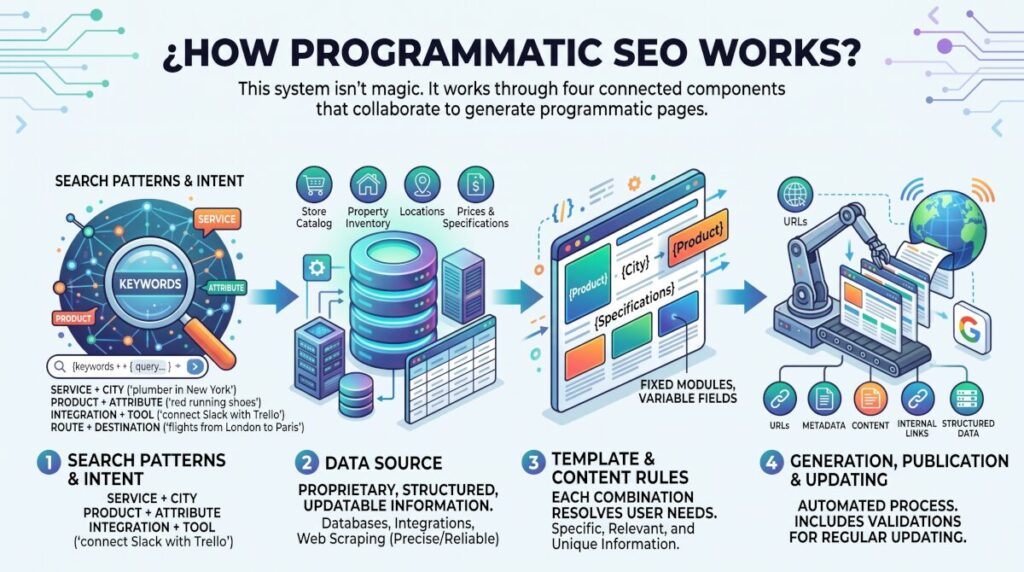
Search Patterns and Intent
The first step is to identify search queries that repeat and combine variables. For example:
- Service + city (“locksmith in Madrid”)
- Product + attribute (“red running shoes”)
- Integration + tool (“connect Slack with Trello”)
- Route + destination (“flights from Lima to Bogotá”)
Data Source
You need your own structured, updatable information. This can be your store’s catalog, property inventory, branch locations, prices, technical specifications, or statistics. Sometimes this information is obtained through internal databases, software integrations, or techniques such as web scraping, as long as the data is accurate and reliable.
Template and Content Rules
SEO templates are defined with fixed modules and variable fields. The goal is not to create exact copies that only change one word. Each combination must solve the user’s need by displaying specific, relevant, and unique information.
Generation, Publishing, and Updating
Finally, the system automates the creation of URLs, metadata, visible content, internal links, and structured data markup. This process must include validations to ensure the information is updated regularly.
Programmatic SEO vs. Traditional SEO: What Are the Differences?
| Feature | Traditional SEO | Programmatic SEO |
| Scale | Dozens to hundreds of pages. | Thousands or tens of thousands of pages. |
| Keyword type | Unique queries with high or medium volume. | Repeatable patterns with low volume but high conversion. |
| Content source | Manual, creative writing. | Databases and design templates. |
| Production | Handcrafted, page by page. | Systematized through code rules. |
| Maintenance | Individual manual editing. | Centralized database updates. |
| Quality control | Direct editorial review. | Validation rules, filters, and sample-based monitoring. |
| Use cases | Blog articles, core service pages, home page. | Product pages, local pages, comparison tools, directories. |
What Types of Sites Can Apply Programmatic SEO?
Not every project needs this approach, but it is highly effective for:
- E-commerce sites and marketplaces.
- Travel and ticket booking platforms.
- Real estate companies.
- Local directories and job boards.
- Software with integration directories.
- Financial platforms or platforms with comparable data.
Programmatic SEO Examples
Programmatic content is not a one-size-fits-all template. It works differently depending on the industry.
Location Pages
Example: Car rental in [city]. Changing the city name in the title is not enough. For the page to have value, it must display the actual inventory available at that location, local pickup and delivery conditions, a map of the branch, and a clear call to action (CTA) to book.
Category and Attribute Pages
Example: [Brand] sneakers for [use] in [color]. This URL must display products that exactly match those attributes. It needs accurate images, specifications, size availability, and useful filters to refine the search.
Comparison or Integration Pages
Example: [Tool A] vs. [Tool B]. Users are looking for concrete data. The page must provide real price comparison tables, a list of verifiable features, and objective pros and cons. The information must highlight real differences, not generic text.
When Is It Worth Implementing a Programmatic SEO Strategy?
- There is repeatable search demand with a broad set of combinations.
- You have reliable, complete, and structured data.
- You can deliver real differential value on each generated page.
- You have the technical capacity to build the system.
- You have a process in place to keep the data up to date.
When Is Programmatic SEO Not a Good Idea?
- The search variations have no volume or demand.
- Your databases are incomplete or contain errors.
- Your company lacks the technical resources to sustain the structure.
- The only goal is to multiply URLs to try to capture traffic without offering useful content.
How to Implement Programmatic SEO Step by Step
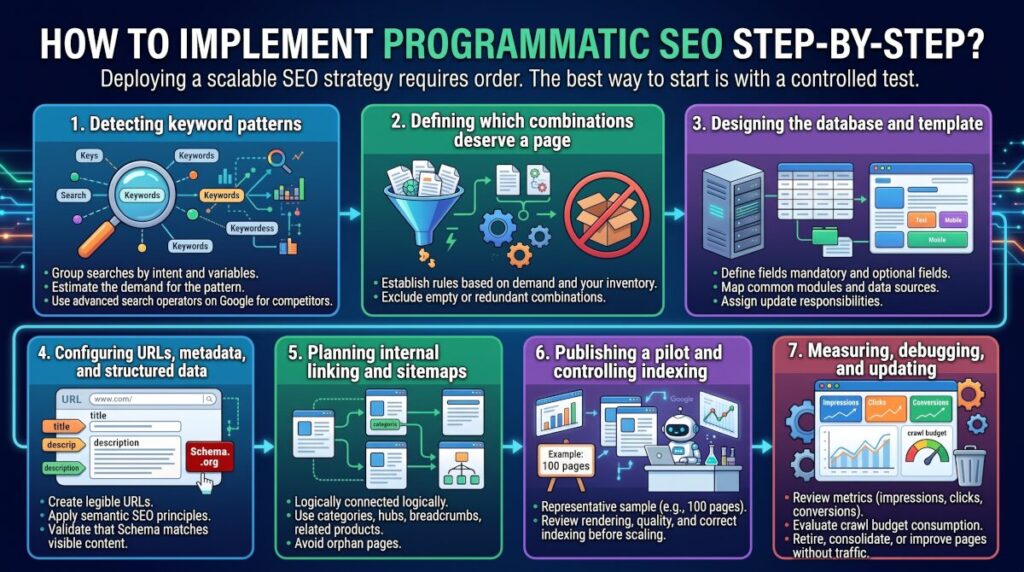
- Detect keyword patterns: Group searches by intent and variables. You can use advanced Google search operators to review how competitors are addressing these queries.
- Define which combinations deserve a page: Exclude empty or redundant combinations.
- Design the database and the template: Define required/optional fields and data sources.
- Set up URLs, metadata, and structured data: Apply semantic SEO principles so that metadata reflects user intent.
- Plan internal linking and sitemaps: Use categories, hubs, breadcrumbs, and related products.
- Publish a pilot and monitor indexing: Launch a small sample and review performance before scaling.
- Measure, refine, and update: Review metrics and remove pages that do not add value.
Risks and Common Mistakes
The biggest risk is generating duplicate, shallow, or empty content. Other problems include displaying outdated data or replicating design flaws. This affects your online reputation and may be considered SEO over-optimization.
How to Avoid Scaled Content Abuse
Mass-generating text with AI without supervision is spam. Review the official policies: Google: Spam policies – scaled content abuse.
How to Measure Performance?
Do not measure success by the number of pages alone. Segment by template and measure: indexing coverage, organic impressions, conversions, average business value per page, and maintenance costs.
Scale Your Organic Visibility with a Sustainable SEO Strategy
Programmatic SEO is a discipline that combines research, reliable data, technical development, and strict quality control. A digital marketing agency can help you assess whether your site is ready for this approach.
If you are looking to grow safely, contact our SEO agency at MD Marketing Digital. We help you evaluate the opportunity, design a pilot project, and scale useful pages without compromising your site’s technical health.

- Programmatic SEO: What It Is, How It Works, and When to Implement It - October 2, 2026
- International SEO: How to Rank a Website in Different Countries and Languages? - September 25, 2026
- Crawl budget: what it is and how to optimize the crawling of a website - September 18, 2026
¿Qué te pareció este artículo?
What do you think about this post?