
Read AI summary
Replicating or translating a website is not enough to compete organically in other markets. Audiences search differently depending on their location, and search engines evaluate your site’s local relevance before displaying it.
Understanding the evolution of the Internet and the market shows us that personalization is key. To reach other countries successfully, you need a structured strategy. Below, we explain how to do it.

What Is International SEO?
International SEO is the set of technical, content, and authority strategies aimed at improving a website’s organic visibility across different countries, regions, or languages. It is not just about translating text, but about adapting the user experience and technical signals so that search engines understand which specific audience you are targeting. Good international search engine positioning aligns your value proposition with local search intent.
Multilingual SEO vs. Multiregional SEO: What’s the Difference?
It is common to confuse these terms. A project may require one of these approaches or combine both.
| Concept | Definition | Example |
| Multilingual SEO | Offers the same site or content in more than one language, without being limited to a specific country. | A software site available in Spanish and English. |
| Multiregional SEO | Explicitly targets users in different countries, adapting the local offering. | An online store with versions for Argentina, Mexico, and Chile. |
How to Know Which Countries and Languages Are Worth Targeting?
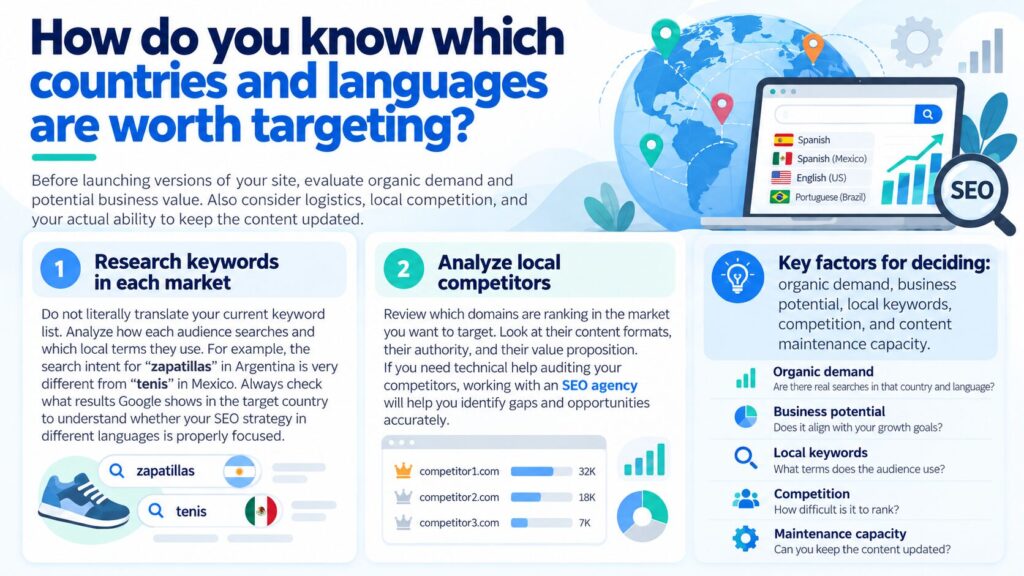
Before launching versions of your site, evaluate organic demand and potential business. Also consider logistics, local competition, and your real capacity to keep the content up to date.
Research Keywords in Each Market
Do not literally translate your current keyword list. Analyze how each audience searches and which local terms they use. For example, the search intent behind “zapatillas” in Argentina is very different from “tenis” in Mexico. Always check which results Google shows in the target country to understand whether your SEO strategy in different languages is properly focused.
Analyze Local Competitors
Review which domains are ranking in the market you want to enter. Observe their content formats, their authority, and their value proposition. If you need technical help auditing your competitors, working with an SEO agency will allow you to identify gaps and opportunities accurately.
Which Website Structure Is Best for an International SEO Strategy?
The international URL structure is the foundation of your project. There is no single valid architecture; the choice depends on your business model, your domain’s current authority, and your technical resources.
| Structure | Example | Advantages | Disadvantages |
| Country-code domains (ccTLD) | domain.com.ar, domain.mx | Very clear geographic signal for search engines and local users. | Requires greater investment, infrastructure, and building authority from scratch for each one. |
| Subdomains | ar.domain.com, es.domain.com | Operational flexibility. Allows separating servers by country. | Authority is not always fully transferred from the main domain. |
| Subdirectories | domain.com/ar/, domain.com/es/ | Easier to manage. Consolidates authority in a single domain. | Weaker local geographic signal if not configured properly. |
How to Implement Hreflang Correctly?
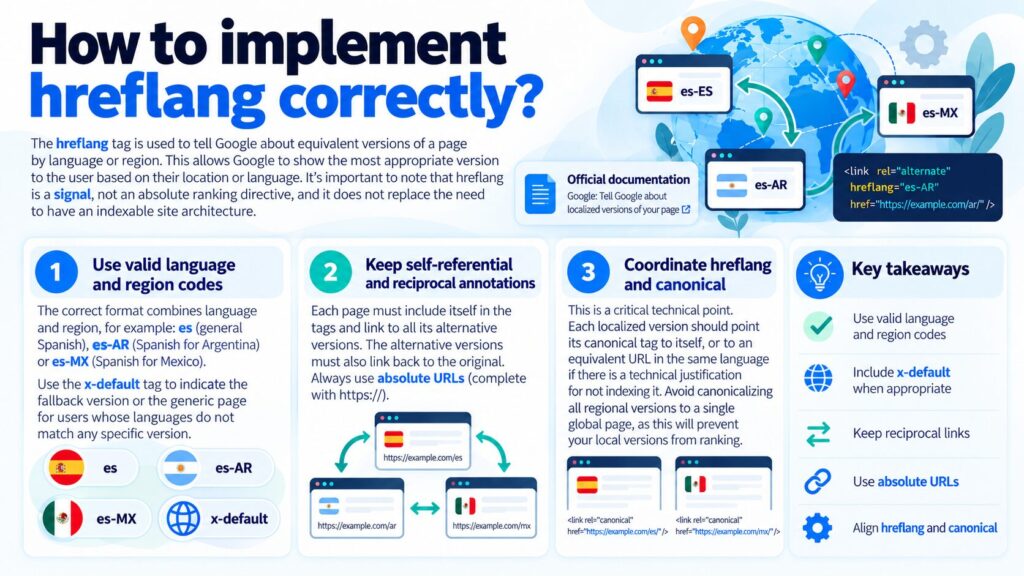
The hreflang tag is used to tell Google the equivalent versions of a page by language or region. This allows it to display the most appropriate version to the user based on their location or language. It is important to clarify that hreflang is a signal, not an absolute ranking directive, and it does not replace the need for an indexable architecture.
For more detail on the technical guidelines, you can consult the official documentation: Google: Tell Google about localized versions of your page.
Use Valid Language and Region Codes
The correct format combines language and region, for example: es (general Spanish), es-AR (Spanish for Argentina), or es-MX (Spanish for Mexico). Use the x-default tag to indicate the fallback version or the generic page for users whose languages do not match any specific version.
Keep Annotations Self-Referencing and Reciprocal
Each page must include itself in the tags and link to all of its alternates. The alternate versions must also link back to the original. Always make sure to use absolute URLs (complete, with https://).
Coordinate Hreflang and Canonical
This is a critical technical point. Each localized version must point its canonical tag to itself, or to an equivalent URL in the same language if there is a technical justification for not indexing it. Avoid canonicalizing all regional versions to a single global page, as this will prevent your local versions from ranking.
How to Adapt Content to Each Country and Language?
Translating is not localizing. To connect with the audience, you need to adapt vocabulary, currency, units of measurement, cultural references, and even images. You must also adjust for legislation, shipping options, and payment methods. A localized site builds trust and improves conversion rates.
Signals That Help Rankings in International Markets
Beyond structure and tags, Google evaluates other local signals. It is essential to develop truly localized content and earn backlinks from relevant sites in that country. Keeping business information consistent (local physical addresses and phone numbers) reinforces your presence. Understanding the behavior of social consumers in each region will also help you gain visibility and genuine brand mentions.
How to Build an International SEO Strategy Step by Step
If you want to do SEO for multiple countries, follow this order of work:
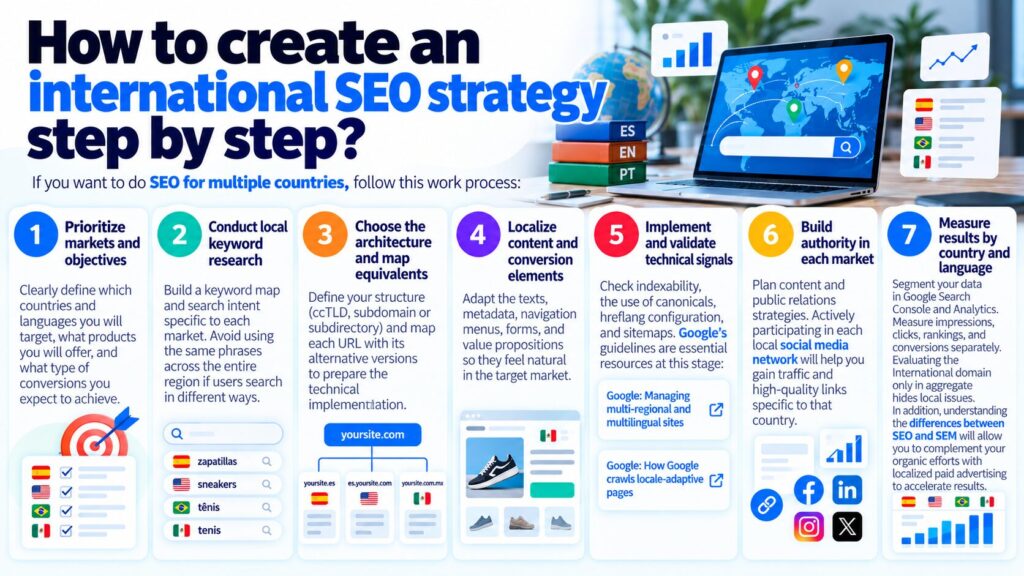
- Prioritize markets and goals: Clearly define which countries and languages you will target, which products you will offer, and what type of conversions you expect to achieve.
- Conduct local keyword research: Build a keyword and search intent map specific to each market. Avoid using the same phrases for the entire region if users search differently.
- Choose the architecture and map equivalences: Define your structure (ccTLD, subdomain, or subdirectory) and link each URL to its alternate versions to prepare the technical implementation.
- Localize content and conversion elements: Adjust copy, metadata, navigation menus, forms, and sales arguments so they feel natural in the target market.
- Implement and validate technical signals: Review indexability, canonical usage, hreflang configuration, and sitemaps. The guidelines in Google: Managing multi-regional and multilingual sites and Google: How Google crawls locale-adaptive pages are essential resources at this stage.
- Develop authority in each market: Plan content and public relations strategies. Actively participating in each local social media network will help you earn quality traffic and links specific to that country.
- Measure results by country and language: Segment your data in Google Search Console and Analytics. Measure impressions, clicks, positions, and conversions separately. Evaluating the international domain only in aggregate hides local problems. In addition, understanding the differences between SEO and SEM will allow you to complement your organic efforts with localized paid campaigns to accelerate results.
Common International SEO Mistakes
There are failures that can compromise the entire project. These are the mistakes you must avoid:
- Believing Google uses the HTML lang tag: Google ignores the HTML lang attribute when identifying a page’s language. It uses the page’s actual content and hreflang tags.
- Automatic IP-based redirects: Do not impose mandatory redirects based on the user’s location or browser language. This frustrates users and makes it harder for Google’s bots to crawl all your versions. Prioritize separate, accessible URLs.
- Mixing languages: Avoid including content in multiple languages within the same URL.
- Hreflang errors: Using made-up codes, omitting link reciprocity, or implementing the tag incompletely.
- False expansion: Publishing sections for markets or countries that your company has no real capacity to serve commercially.
Conclusion: Expand Your Business’s International Visibility with MD Marketing Digital
Ranking a site in other markets demands much more than translating text. It requires in-depth research, clear decisions about technical architecture, and meticulous localization work to build trust with the new audience.
If you are looking to expand your borders and need technical and strategic support, contact our digital marketing agency. At MD Marketing Digital, we design results-oriented international SEO strategies aligned with your brand’s real business opportunities.
Which international market would you like to rank your website in first?

- International SEO: How to Rank a Website in Different Countries and Languages? - September 25, 2026
- Crawl budget: what it is and how to optimize the crawling of a website - September 18, 2026
- Omnichannel Marketing: What It Is and How to Integrate a Brand’s Channels - August 28, 2026
¿Qué te pareció este artículo?
What do you think about this post?