
Read AI summary
According to a study by SparkToro in collaboration with Semrush, which analyzed 332 million Google searches, 52.65% of searches are informational in nature. People are not looking for pages; they are looking for answers. And Google has been built precisely for that purpose for years.
That is the root of the change. SEO based on repeating keywords lost effectiveness because search engines stopped reading words and started reading intent. The mechanism behind that transformation has a name: semantic search.
Understanding how it works is the starting point for any company that wants to rank strategically and attract qualified traffic. We have already covered it on our blog as part of what it means to build an SEO strategy today. Here, we take a deeper look.

What is semantic search?
Semantic search is a search engine’s ability to interpret the meaning and intent behind a query, rather than looking for exact text matches.
When someone types “how to reduce a fever quickly?”, Google does not scan for pages containing those exact words in that exact order. It analyzes the context: an informational query with a sense of urgency from a user looking for a practical answer. That determines which results are shown, not a literal match.
The previous model, keyword matching, paired queries with documents containing the same terms. It worked to a certain extent, but it was easy to manipulate and often failed to satisfy users: two people searching for the same thing using different phrases could receive different results even though they needed the same answer.
Semantic search closes that gap. It interprets synonyms, variations, user context, and relationships between concepts to deliver results that answer what the user intended to ask, not just how the query was written.
👉 What’s better for your site: a domain with or without www? In our latest article, we tell you which option to choose and how to configure it correctly to avoid SEO problems.
How semantic search works in Google
What we now call semantic search is the result of multiple layers of technology working simultaneously: artificial intelligence, natural language processing (NLP), and machine learning. Google has spent more than a decade refining this system, with milestones that have continually reshaped the SEO landscape.
Broadly speaking, the process follows this logic:
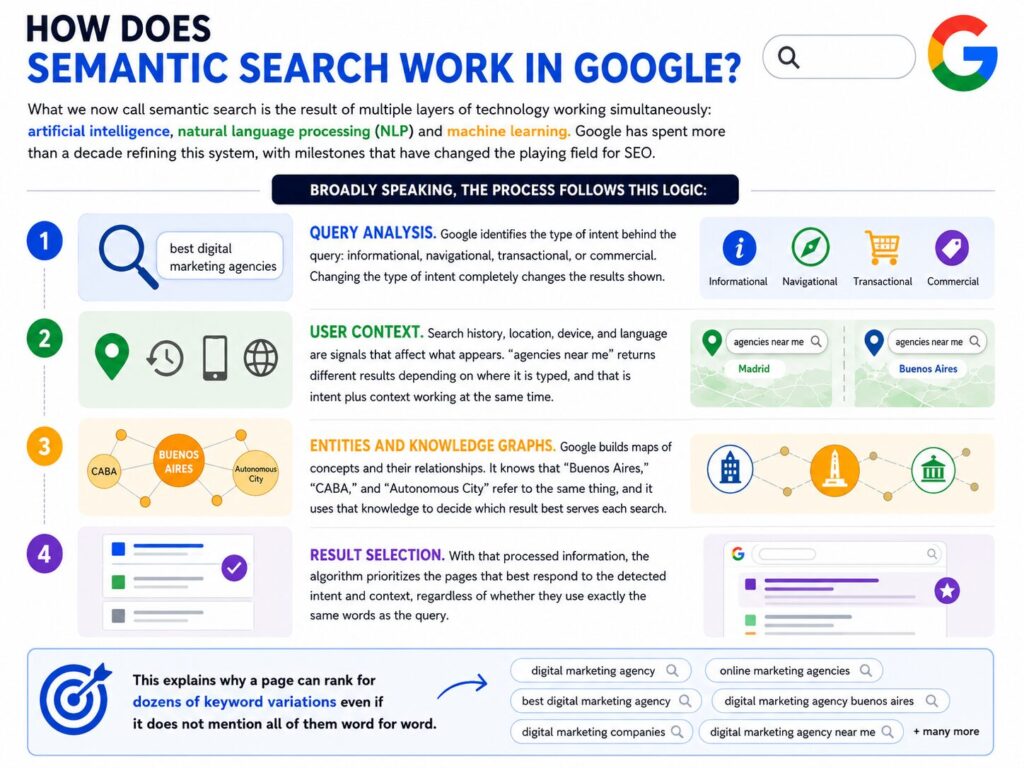
- Query analysis. Google identifies the type of intent behind the search: informational, navigational, transactional, or commercial. Changing the intent type completely changes the results that are displayed.
- User context. Search history, location, device, and language are signals that influence what appears. A search like “agencies near me” returns different results depending on where it is entered, with intent and context working together at the same time.
- Entities and knowledge graphs. Google builds maps of concepts and their relationships. It understands that “Buenos Aires,” “CABA,” and “Autonomous City” refer to the same place, and uses that knowledge to determine which result best serves each search.
- Result selection. With that information processed, the algorithm prioritizes the pages that best satisfy the detected intent and context, regardless of whether they use the exact same words as the query.
This explains why a page can rank for dozens of keyword variations even if it does not explicitly mention all of them.
The role of artificial intelligence in semantic search.
AI is what makes all of this possible at scale. Without it, processing billions of queries with linguistic nuances every day would be unfeasible.
Natural language processing (NLP) allows Google to understand human language, including its ambiguities and complex structures. BERT, launched in 2019 and officially announced on Google’s blog, was a turning point: it gave the search engine the ability to understand words within their full context rather than in isolation. Later came MUM (Multitask Unified Model), offering a deeper understanding of long-form content and multimodal queries.
That same semantic logic is now present in virtual assistants and voice search. When someone speaks to their phone and asks a conversational question, the system interpreting that query is the same one operating behind organic search results. That is why optimizing for semantic search also means optimizing for these formats. If you want to explore the relationship between AI and search visibility further, we have an article on SEO for LLMs that approaches the topic from another angle.
Types of semantic search
Within the semantic model, different mechanisms operate depending on the type of query and the user’s context.
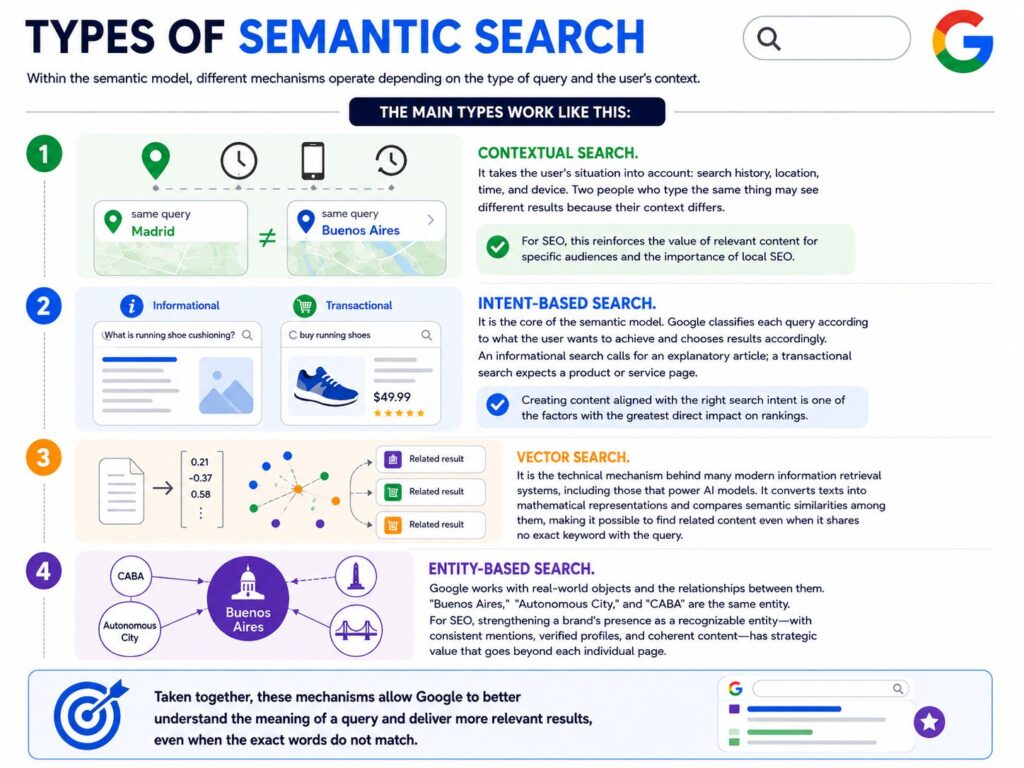
- Contextual search: takes the user’s situation into account—search history, location, time, and device. Two people entering the same query may see different results because their contexts differ. For SEO, this reinforces the value of content that is relevant to specific audiences and the importance of local SEO efforts.
- Intent-based search: this is the core of the semantic model. Google classifies each query according to what the user wants to achieve and selects results accordingly: an informational search calls for an explanatory article, while a transactional search expects a product or service page. Creating content aligned with the correct search intent is one of the factors with the greatest direct impact on rankings.
- Vector search: this is the technical mechanism behind many modern information retrieval systems, including those that power AI models. It converts text into mathematical representations and compares semantic similarities between them, making it possible to find related content even when it shares no exact keywords with the query.
- Entity-based search: Google works with real-world objects and the relationships between them. “Buenos Aires,” “Autonomous City,” and “CABA” are the same entity. For SEO, strengthening a brand’s presence as a recognizable entity—with consistent mentions, verified profiles, and coherent content—has strategic value that goes beyond any individual page.
How to optimize your SEO for semantic search
Understanding the model is only half the job. These are the strategies with the greatest real-world impact. If you want to see how they connect with SEO as a whole, that article is a good place to start.
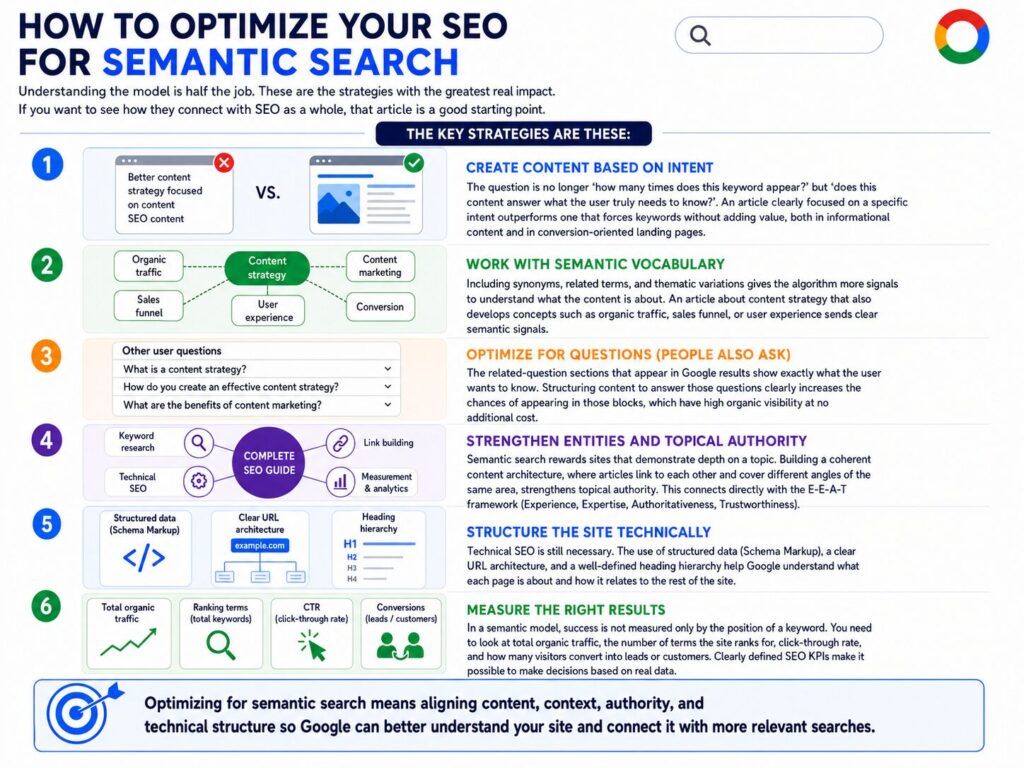
Create content based on intent, not keyword density
The question is no longer “How many times does this keyword appear?” but rather “Does this content answer what the user actually needs to know?” An article that is well focused on a specific intent will outperform one that forces keywords without providing value, whether it is informational content or a conversion-oriented landing page.
Work with semantic vocabulary, not just exact-match keywords
Including synonyms, related terms, and topical variations gives the algorithm more signals to understand what the content is about. An article on content strategy that also explores concepts such as organic traffic, sales funnels, or user experience is sending clear semantic signals—not because SEO mechanically requires it, but because a well-developed article naturally includes them.
Optimize for questions (People Also Ask)
The related question sections that appear in Google search results show exactly what users want to know. Structuring content to answer those questions clearly increases the chances of appearing in these blocks, which offer high organic visibility at no additional cost.
Strengthen entities and topical authority.
Semantic search rewards sites that demonstrate depth on a topic. Building a coherent content architecture, where articles link to one another and cover different angles of the same subject area, strengthens topical authority in the eyes of the algorithm.
This is directly connected to the E-E-A-T framework (Experience, Expertise, Authoritativeness, and Trustworthiness) that Google uses to evaluate content quality, as detailed in its Search Quality Rater Guidelines, updated in September 2025.
Structure your site technically so Google can understand the content
Technical SEO remains essential. Using structured data (Schema Markup), a clear URL architecture, and a well-defined heading hierarchy helps search engines understand what each page is about and how it relates to the rest of the site.
Measure the right results
In a semantic search model, success is not measured solely by the ranking of a single keyword. You need to look at total organic traffic, the number of terms for which the site ranks, click-through rate, and how many visitors convert into leads or customers. Having clearly defined SEO KPIs is what enables data-driven decision-making.
Frequently Asked Questions About Semantic Search
Does semantic search replace traditional SEO?
No, it does not replace it—it evolves it. Traditional technical practices such as site speed, indexing, URL structure, and metadata remain essential. What changes is the focus of content: from optimizing for exact-match keywords to optimizing for intent and topics. Semantic SEO and technical SEO work together.
How do I know if my content is aligned with semantic search?
One clear indicator is the number of different terms for which a single page ranks. If an article ranks only for the exact keyword it was written around and nothing else, it is probably optimized too rigidly. Semantically well-structured content typically attracts traffic from dozens of related variations that were never explicitly targeted during the writing process.
What is an entity in the context of semantic search?
An entity is anything Google can identify as a distinct real-world object: a person, a company, a place, or a concept. Google builds relationships between entities to understand the context of a page. For SEO, developing a brand as a recognizable entity—with consistent mentions, verified profiles, and coherent content—improves how the algorithm interprets and ranks it.
Does it make sense to optimize for semantic search if my business is local?
It makes even more sense. According to a Google statistic consistently cited by BrightLocal and other leading local SEO sources, 46% of Google searches have local intent. Semantic search interprets queries such as “emergency plumber” or “marketing agency in Palermo” by understanding the combination of intent and geographic context. Optimizing for that intersection—with relevant content and structured local business data—is one of the most direct opportunities offered by the semantic search model.
How does semantic search relate to generative AI?
They are part of the same paradigm shift. Semantic search enabled Google to interpret human language with a high degree of accuracy, and that same capability now powers the AI-generated summaries (AI Overviews) that appear in search results. Content that effectively satisfies search intent and demonstrates topical authority has a greater chance of being cited in those responses. We explore this in detail in our article on GEO vs. SEO.
Conclusions
Semantic search is neither a new concept nor a passing trend. It is the model on which Google has operated for more than a decade, and the direction toward which all recent developments in AI-powered search are converging.
For businesses, the shift in focus is clear: SEO that delivers results starts with the user, understands what they need at each stage of their search journey, and creates content that responds to those needs with precision. Consistently doing that over time is what translates into qualified traffic, better conversions, and an organic presence that does not depend on a static ranking.
Want to implement a strategy aligned with semantic search? Let’s talk.

- Performance Max: What It Is and How to Optimize Campaigns in Google Ads - October 20, 2026
- How to Appear in AI Overviews: GEO Keys to Gain Visibility on Google - October 13, 2026
- Programmatic SEO: What It Is, How It Works, and When to Implement It - October 2, 2026
¿Qué te pareció este artículo?
What do you think about this post?