
Read AI summary
The way people search for information online has changed completely. When you ask a question, Google no longer limits itself to showing you a list of links: at the top of the screen, a direct answer written by artificial intelligence appears.
That block is called AI Overviews. If your brand does not appear as a source in those answers, you are missing out on organic traffic that is extremely valuable. Traditional SEO is still necessary, but on its own it is no longer enough. To maintain visibility, you need to add generative engine optimization (GEO) techniques and adapt your content to how the new language models work.
Here we explain what these generative answers are, how they work, and what you can do to get Google to cite your website.

What Are AI Overviews and How Are They Transforming Search?
AI Overviews are summaries generated by artificial intelligence that appear before the traditional results. Google uses its language models and a technique called query fan out to analyze different web pages, synthesize the relevant information, and build a unified answer.
This feature transforms the way users search:
- Direct answers: the user resolves their question without needing to click through to a page.
- Increase in no-click searches: when the answer is found right at the top, clicks to the usual web results drop.
- New visibility metrics: success is no longer measured only by reaching the first spot on the list, but by getting the AI to cite your brand as an authoritative source.
Appearing in AI Overviews lets you capture people’s attention right when they are looking for a solution, which reinforces trust in your business.
What Is GEO (Generative Engine Optimization) and How Does It Differ from Traditional SEO?
Generative engine optimization (GEO) is the set of practices designed to optimize content so that AI models choose it as a reference in their answers.
While traditional SEO seeks to place a specific URL in the results through keywords and links, GEO seeks to feed the general knowledge of language models. The goal is for the AI to recognize your company as an authority on its topic.
Comparison: Traditional SEO vs. GEO
| Criterion | Traditional SEO | GEO (Generative Engine Optimization) |
|---|---|---|
| Main objective | Rank web pages among the first blue links. | Appear as a cited source in the AI’s answer. |
| Key metric | Clicks, impressions, and organic web traffic. | Brand mentions, citations, and direct visibility. |
| Content approach | Keyword density and search volume. | Conceptual clarity, accurate data, and entities. |
| Authority assessment | Inbound links (backlinks) and domain authority. | Consistency of the business across the web and data validation. |
Integrating SEO and GEO into your digital plan is the most solid way to protect your website’s traffic in the long term.
Key Factors for Optimizing Content and Appearing in AI Answers
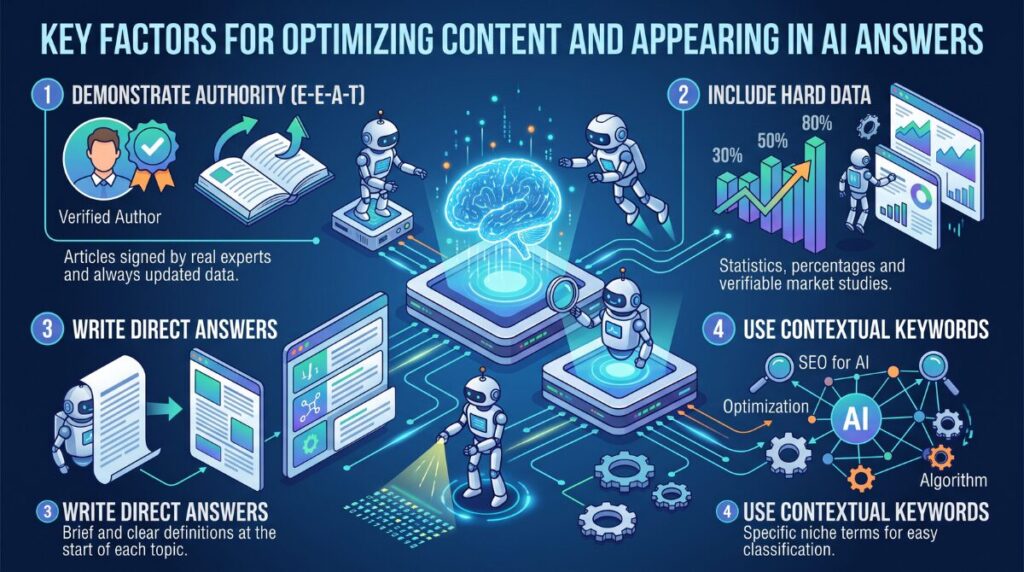
Language models, or LLMs, choose their sources based on the clarity, accuracy, and credibility of the data. That is why, if you want to know how to appear in AI Overviews, it is worth structuring your texts with how these algorithms process information in mind.
1. Demonstrate experience and authority (E-E-A-T) Google prioritizes content created by real experts. To meet this requirement:
- Publish articles signed by professionals in the field.
- Add author pages with clear biographies and links to verifiable professional profiles.
- Keep your data and reports always up to date.
2. Include hard data and statistics: artificial intelligences look for concrete facts. Including figures, percentages, market studies, and verifiable statistics increases the likelihood that the system will use your content as a reference.
3. Write direct answers: write brief, clear definitions at the start of each topic. A concise paragraph of two or three sentences makes it easier for the bot to extract that answer and display it directly in the generative summary.
4. Use contextual keywords: using terms such as SEO for AI, SEO for artificial intelligence, and optimization for AI Overviews within the text helps the algorithm classify your content within the right niche.
How to Structure Information and Use Entities to Make Crawling Easier
AI does not read a text linearly the way a person does. It analyzes entities (that is, well-defined concepts, brands, products, or people) and understands how they relate to one another, which is the basis of semantic SEO.
To make Google’s crawler’s job easier, you can follow these formatting guidelines:
- Implement structured data (Schema.org): using Schema markup helps search engines understand what type of information you publish (articles, FAQs, or services).
- Use lists and tables: generative models process information organized in bullet points or comparison tables much better than long texts in continuous paragraphs.
- Define concepts up front: when introducing a new term, write a simple definition immediately after mentioning it.
Advanced Strategies to Increase Your Brand’s Citations
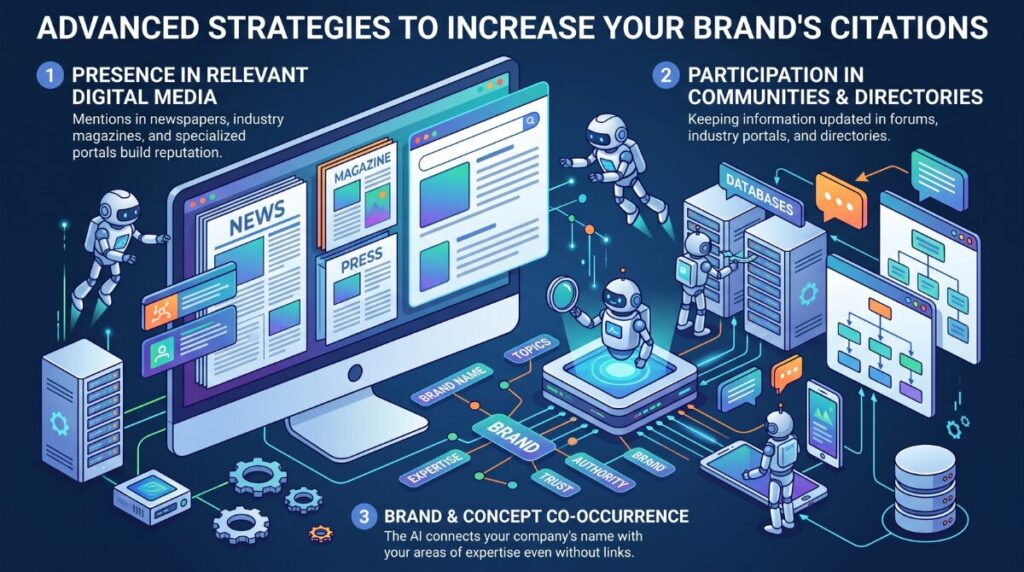
Algorithms do not just read your website. They analyze what the web says about your business across different channels. To boost your brand’s citations in generated answers, you can implement these actions:
- Presence in relevant digital media: mentions in newspapers, industry magazines, and specialized portals build reputation. The AI consults these media to confirm whether a brand is relevant.
- Participation in communities and directories: keeping information up to date in forums, industry portals, and directories helps feed the databases of language models.
- Co-occurrence of brand and concepts: even if a mention does not carry a web link, the system records your company’s name alongside your areas of expertise. The more often they appear together, the more authority the AI will grant you.
Get Ready for the Future of Digital Rankings with MD Marketing Digital
Web rankings have changed once again: optimizing keywords to climb the list of blue links is still necessary, but it is no longer enough. Now, content also has to respond to what artificial intelligence and generative search demand.
If you want to adapt your website and get your company to appear in the answers generated by Google, at MD Marketing Digital we can help you. We develop customized SEO for AI strategies and work on optimization for AI Overviews to protect your business’s visibility.
Contact us and let’s review your brand’s digital presence together, so we can take the next step toward the future of web search.

- How to Appear in AI Overviews: GEO Keys to Gain Visibility on Google - October 13, 2026
- Programmatic SEO: What It Is, How It Works, and When to Implement It - October 2, 2026
- International SEO: How to Rank a Website in Different Countries and Languages? - September 25, 2026
¿Qué te pareció este artículo?
What do you think about this post?