

Read AI summary
You have the product, you have the drive to sell online, and now you’re missing the most important decision: where are you going to build your store?
The prestashop vs woocommerce comparison comes down to four concrete factors: your catalog, your budget, your team’s technical level, and the digital marketing strategy you have in mind.

What Sets WooCommerce Apart from PrestaShop?
The core difference lies in each platform’s starting point. WooCommerce is a plugin that installs on top of WordPress and turns your site into an online store. PrestaShop, on the other hand, was born as a platform designed specifically for e-commerce, without depending on an external CMS.
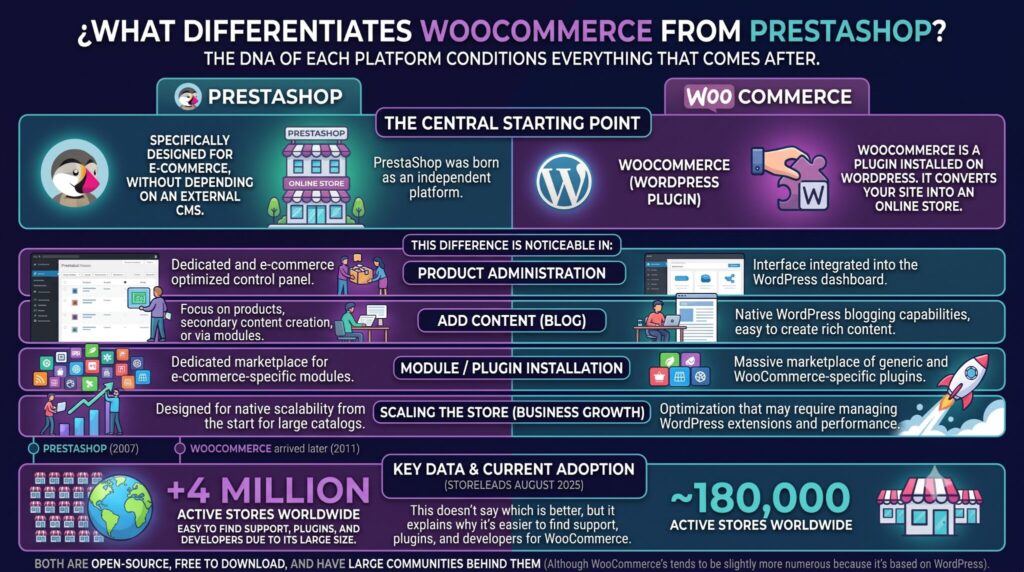
That difference in origin shows in:
- How you manage products.
- How you add content.
- How easy it is to install a new module or plugin.
- How simple it is to scale the store as the business grows.
Both are open source and free to download, and both have a large user community behind them, although WooCommerce’s tends to be somewhat larger because it builds on the WordPress base. The DNA they were built with is what ends up shaping everything that comes after.
PrestaShop has been around since 2007; WooCommerce arrived later, in 2011. Today WooCommerce has a considerably larger base of active stores (more than 4 million worldwide), while PrestaShop sits at around 180,000, according to StoreLeads data collected in August 2025. That doesn’t tell you which one is better, but it does explain why it’s easier to find support, plugins, and developers for WooCommerce.
👉 Discover what vibe coding is and how to apply it effectively in our new article.
When Is WooCommerce the Right Choice?
If you already have a WordPress site, or if your sales strategy relies heavily on content, blogging, and organic rankings, WooCommerce is usually the path of least friction. Since it lives inside WordPress, managing pages, articles, and categories is integrated with the same logic you already use (or will only have to learn once) to run the store.
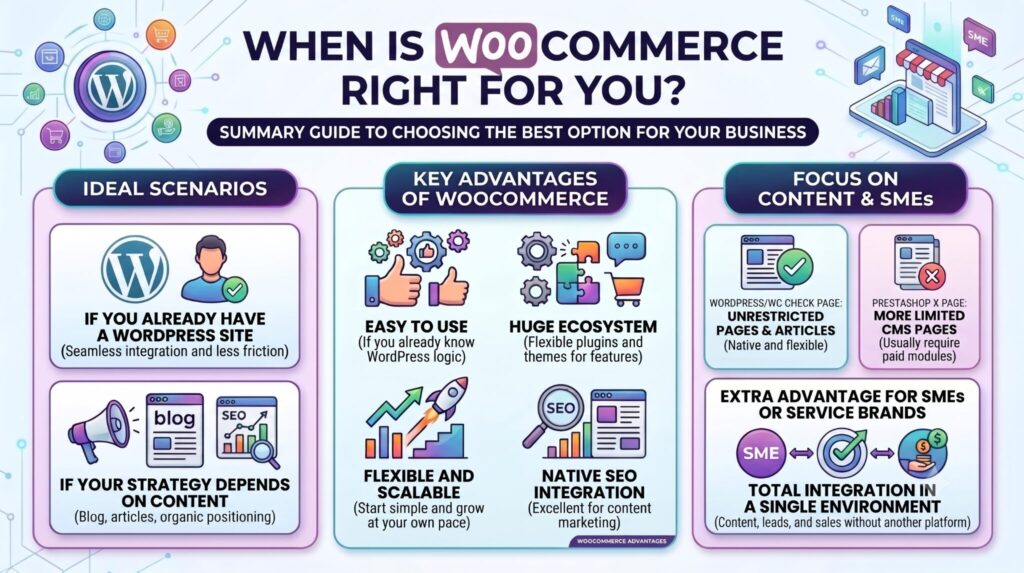
Among its most concrete advantages:
- Ease of use if you already work with WordPress.
- A huge ecosystem of plugins and themes.
- Flexibility to add features as you need them.
- Good integration with SEO and content marketing strategies.
- The ability to start simple and scale gradually, without having to plan everything from day one.
This is no small detail if organic positioning is central to your strategy: WooCommerce content pages are WordPress articles and pages with no restrictions, while PrestaShop’s CMS pages are more limited for that kind of work and usually require a paid module to come close to what WordPress offers out of the box.
For SMBs or service brands just starting to sell products online, this carries extra value: you can integrate content, lead generation, and sales in the same environment, without adding yet another platform to the equation.
👉 Want to know what international SEO is and how to grow your website in other countries? Read our latest article and discover the keys to achieving it.
When Is PrestaShop the Right Choice?
If your priority is e-commerce itself (a large catalog, multiple currencies or languages, fine-grained stock management, and payment methods), PrestaShop gives you a more robust foundation from the start, without depending on adding plugin after plugin to cover the basics.
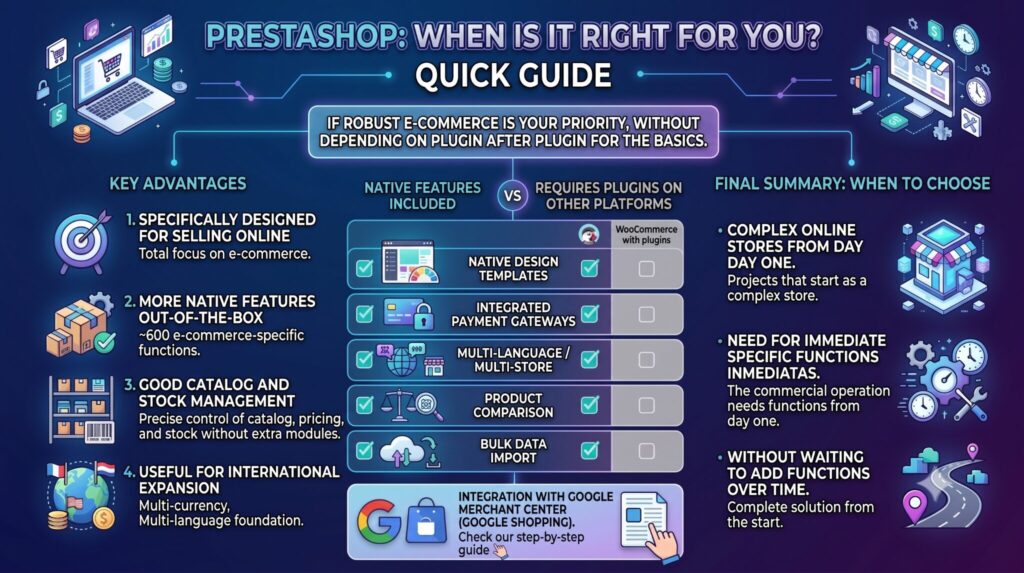
Its clearest advantages:
- It’s a platform designed specifically for selling online.
- It comes with more native e-commerce features out of the box.
- Good catalog, pricing, and stock management with no need for extra modules.
- Useful options if your store has or will have international reach.
- The ability to work with specialized modules for your industry.
PrestaShop includes around 600 e-commerce-oriented features out of the box. These include, among other things, its own design templates and pre-integrated payment gateways. Several of those features (multi-language, multi-store, product comparison, bulk data import) require installing specific plugins in WooCommerce.
If you also sell through Google Shopping, it’s worth checking out our article on how to integrate your store with Google Merchant Center, where you’ll find the step-by-step guide for both WooCommerce and PrestaShop.
PrestaShop tends to be the more convenient option when the project is born directly as a complex online store, or when the business operation needs specific features from day one and it makes no sense to wait and “add things over time.”
How Much Does Each Platform Cost?
Neither has a licensing fee: both WooCommerce and PrestaShop are free to download and install. The real investment shows up elsewhere.
With WooCommerce, hosting runs between USD 10 and 70 per month depending on the traffic you expect (between USD 120 and 840 per year), and premium plugins average between USD 65 and 90 per year each, according to a survey of more than 5,000 active stores. Adding hosting and a few essential plugins, a small or medium-sized professional store usually ends up costing between USD 1,000 and 3,000 per year.
With PrestaShop, basic hosting starts out cheaper (between USD 4 and 14 per month with entry-level providers), but individual modules cost considerably more per unit: between USD 50 and 500 each, and custom-built modules can exceed USD 1,000, according to a PrestaShop cost guide updated for 2026. With just three or four essential modules, that annual cost can end up in a range similar to WooCommerce’s, or even higher, depending on how many premium modules your business needs.
In no case should you choose a platform based on initial cost alone. The question that matters is how much you’ll end up spending in a year, adding up hosting, extensions, and maintenance.
Performance and Hosting: What to Expect from Each
There’s a myth worth clearing up: your store’s performance depends far more on how your hosting is configured than on whether you chose WooCommerce or PrestaShop.
It’s true that a WooCommerce store running on WordPress with several plugins can generate more database queries, but with well-configured hosting (caching, up-to-date PHP, a good server) it can load as fast as any other option.
PrestaShop, for its part, tends to be more efficient out of the box for large catalogs thanks to its native caching system, although it also depends on hosting to sustain that performance as traffic grows.
In both cases, the recommendation is the same: don’t skimp on hosting if your store is going to handle a considerable volume of visits or orders.
WooCommerce or PrestaShop, Depending on Your Type of Business
There’s no single answer that fits every case. Here’s the point-by-point comparison at a glance:
| Aspect | WooCommerce | PrestaShop |
| Platform type | Plugin on top of WordPress | Standalone e-commerce platform |
| Ease of use | High if you already know WordPress | Somewhat steeper learning curve |
| Native features | Basic, expanded with plugins | Extensive out of the box (~600) |
| Extension costs | USD 65–90/year per plugin on average | USD 50–500 per module |
| Estimated annual cost (hosting + extensions) | USD 1,000–3,000 | Similar or higher, depending on how many modules you need |
| Content and SEO | Strong, inherits everything from WordPress | More limited, requires modules |
| Multi-language and multi-store | Requires plugins | Native |
| Ideal store size | Small to medium | Medium to large |
| International reach | Possible with plugins | Built for it from the start |
A business that already lives in WordPress and wants to add a small or medium-sized store without losing its content strategy will find WooCommerce a natural path.
A project that starts out directly as an e-commerce operation, with a large catalog or the ambition to sell in several countries from the outset, will probably need what PrestaShop offers out of the box.
What to Consider Before Choosing Your Platform?
Before making your decision, there are a few points worth evaluating calmly:
- The size and complexity of your catalog today, and the one you project in one or two years.
- Your real budget, including the paid plugins or modules you’ll need down the road.
- The technical level of your team or the agency that will maintain the store, since PrestaShop’s learning curve tends to be somewhat steeper than WooCommerce’s.
- Your marketing and content strategy, and how integrated you need it to be with the store.
- Your store’s security: on both platforms, it largely depends on keeping the core and the plugins or modules up to date, and on choosing good hosting.
The platform shouldn’t be chosen just for its popularity or for what your competitors use. A rushed choice can later translate into migration costs, complicated integrations, or performance problems that end up costing you time and money.
Frequently Asked Questions About PrestaShop and WooCommerce
Which one is easier to use?
WooCommerce, especially if you already know WordPress. PrestaShop has its own admin panel, with a somewhat steeper learning curve at first.
Which one is cheaper in the long run?
Neither charges a license fee. The difference lies in the cost of extensions: a WooCommerce plugin averages USD 65–90 per year, while a PrestaShop module can cost between USD 50 and 500. Adding hosting, a small or medium-sized store usually runs between USD 1,000 and 3,000 per year on either platform, although PrestaShop tends to push that number upward if you need several premium modules.
Can I migrate my store from one platform to the other later on?
Yes, but it’s neither a simple nor a free process. Migrating products, historical orders, and customers between platforms requires technical planning, so it’s best to choose well from the start to avoid it.
Which one is better for SEO?
WooCommerce has the edge because it inherits all of WordPress’s content flexibility. PrestaShop also allows you to work on SEO, but its static content pages are more limited out of the box.
Do I need technical knowledge to manage either of them?
Not for the basics, but you do to get the most out of them. In both cases, for advanced customizations or to solve performance problems, it’s best to have support from a developer or an agency.
Define Your Platform Before Defining Your Store
Neither WooCommerce nor PrestaShop is the universal answer to the woocommerce vs prestashop question. WooCommerce will serve you better if you’re looking for flexibility, you already have WordPress, and your strategy leans heavily on content. PrestaShop makes sense when the store is the center of the business from day one and you need advanced e-commerce features without depending on external modules.
Before installing either one, it’s worth sitting down to look at the complete business model: catalog, sales goals, SEO strategy, necessary integrations, and real budget. At MD Marketing Digital, we work with clients who are at that exact decision point, and through our web development service we can help you define which platform makes sense for your project. If you’d like to talk it over, contact us.

- Price Research for Google Shopping - October 20, 2026
- WooCommerce vs PrestaShop: Which One Should You Choose in 2026? - July 24, 2026
- Real estate marketing: strategic guide - March 19, 2026
¿Qué te pareció este artículo?
What do you think about this post?