Read AI summary
If your website attracts visitors but doesn’t generate customers, the problem is usually the lack of a conversion funnel that guides the user’s journey. Many of the brands that come to us invest in attracting traffic but don’t know what to do with users once they land on the site. In this article, we’ll look at how to create a path that leads visitors to take the action you need.

What Is a Conversion Funnel in Digital Marketing?
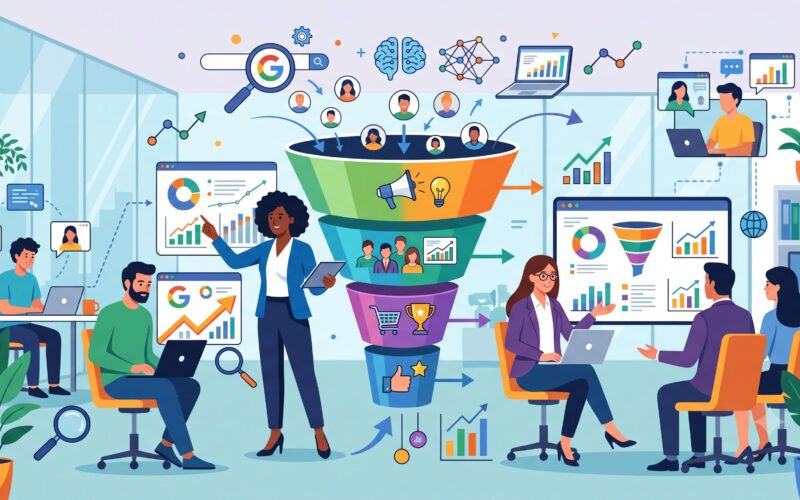
A conversion funnel is the graphic representation of the path a person travels from the moment they discover a brand until they complete a specific action — in other words, a conversion. It’s called a funnel because the flow of users tends to narrow as the journey progresses.
It’s worth clarifying that converting doesn’t always mean selling. The action can be, for example, filling out a form, downloading a guide, scheduling a meeting, subscribing to a newsletter, or requesting a quote, among other things. It all depends on the goal you defined for that particular funnel.
It’s also useful to distinguish the marketing conversion funnel from the sales funnel. The former covers the entire journey, from the moment someone discovers you until they become a lead. The latter starts further along, once that lead is already qualified, and focuses on closing the deal.
Likewise, the conversion funnel is often confused with the customer journey. They’re not the same: the funnel is the map of stages you use to organize your marketing actions, while the customer journey describes the complete experience that person has with your brand, even after the purchase. Working on both together is what allows you to improve the user experience at every touchpoint.
What Is a Conversion Funnel For?
The functions of a conversion funnel are:
- Organizing your marketing actions.
- Adapting your message according to the stage each user is in.
- Measuring precisely where opportunities are being lost.
Let’s look at an example. Two businesses invest the same advertising budget.
The first one only measures how many visits reach its site: when sales don’t materialize, it doesn’t know whether the problem lies in the ads, the website, or the sales process.
The second one has a conversion funnel in place: its report shows that 1,000 people reached the landing page, 300 requested information, and only 10 ended up buying. That data points exactly to where adjustments are needed: the stage between the inquiry and the close is what’s failing, not the advertising or the site.
Stages of the Conversion Funnel
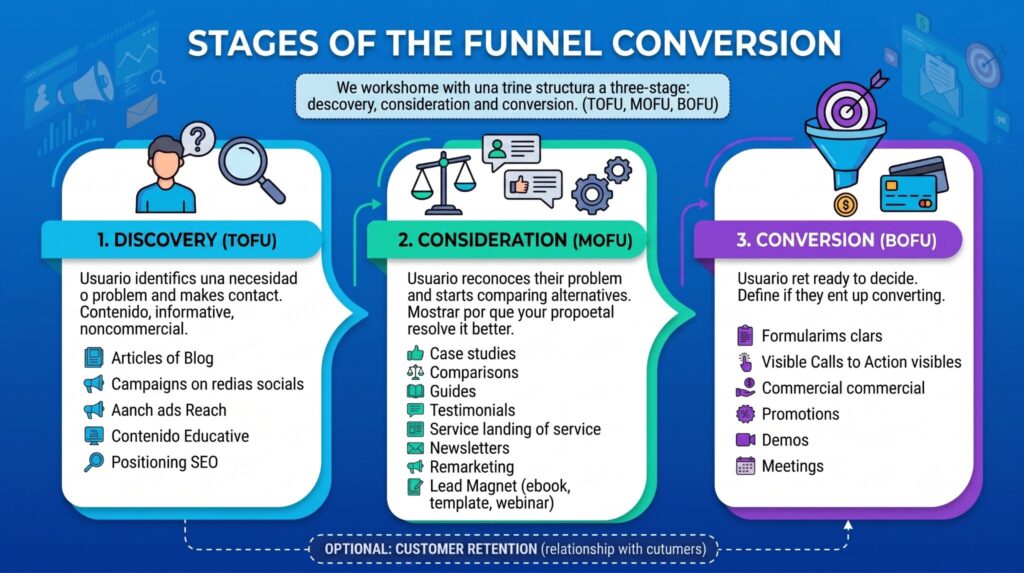
We work with a three-stage structure: awareness, consideration, and conversion. You’ll also find these same stages referred to as TOFU, MOFU, and BOFU (top, middle, and bottom of the funnel), the acronyms commonly used in analytics tools and reports. Some models add a fourth stage, loyalty, when the goal includes nurturing the relationship with existing customers.
1. Awareness
At this stage, the user identifies a need or a problem and comes into contact with your brand for the first time. They don’t know you yet, so the content needs to be informative, not commercial. Some typical actions: blog articles, social media campaigns, reach-focused ads, educational content, and SEO positioning.
2. Consideration
The user already recognizes their problem and starts comparing alternatives. This is the moment to show them why your offer solves that need better: success stories, comparisons, guides, testimonials, service landing pages, newsletters, or remarketing. A good lead magnet (an ebook, a template, or a webinar) also works here: you offer something of value in exchange for their contact information, which allows you to keep nurturing that relationship.
3. Conversion
Here the user is ready to decide. Clear forms, visible calls to action, sales guidance, promotions, demos, or meetings are the tools that determine whether they end up converting or drop off halfway.
A Real Example of a Conversion Funnel
Martín owns a tourism company. His initial problem: low sales. He knew that other agencies in his area had managed to improve theirs by hiring marketing companies, but before making that investment, he wanted to learn more.
He searched for information on Google and found our blog article on digital marketing strategies. The post caught his interest, and he clicked a link that took him to our SEO services landing page.
That’s how he discovered that the website he was visiting offered a solution to his problem, and he decided to get in touch by filling out a form. Our sales team received that information, contacted Martín, and today his problem is solved: his sales have increased.
This example shows that the content, the website, the sales follow-up, and every element involved in the journey need to work in an integrated way. If any of those pieces fails, the funnel breaks before reaching the conversion.
This journey changes if your business is a B2C e-commerce: there, the path is usually shorter, users decide faster, and the weight falls on pricing, shipping, and a simple checkout. The underlying logic doesn’t change — you’re still guiding the user from the moment they discover you until they buy — but the timing and the tools adjust to the type of business.
How to Create a Conversion Funnel Step by Step
Building a conversion funnel doesn’t require a complex structure. These are the core steps:
- Define your conversion goal: it can be a sale, a contact, a demo, a download, or a subscription. This decision is the starting point — everything that follows (the content, the landing pages, the metrics you’ll track) is built around that specific action.
- Identify your target audience and their main needs: what they’re looking for, what stage of the decision they’re in, and what doubts they have before moving forward. The more precise you are here, the easier it is to adapt your message at each stage of the funnel.
- Create specific content for each stage of the funnel: informative content for those who just discovered you, success stories or comparisons for those evaluating alternatives, and direct content for those ready to decide. Using the same message across all three stages is one of the reasons a funnel fails to convert.
- Design clear landing pages and calls to action: a landing page with a single goal and a visible CTA converts better than a page that asks the user to choose between several actions at once.
- Monitor: measure metrics such as conversion rate, bounce rate, acquisition cost, and drop-off at each stage. Without this data, it’s very difficult to understand where the funnel needs adjusting.
- Optimize continuously: a funnel that worked six months ago may need adjustments today. Review which stage loses the most users and test targeted changes there (an email subject line, a shorter form, a different CTA) before rebuilding the entire process from scratch.
Once your funnel is in place, the work is only beginning. Leads that enter through the awareness stage need guidance to reach the conversion, and that’s where lead nurturing comes into play: the strategy that sustains that relationship over time until the user is ready to decide.
Which Metrics to Track in Your Conversion Funnel
Building the funnel is one part of the job; measuring it is the other. The conversion rate tells you what percentage of users complete the action you’re aiming for at each stage, and the bounce rate shows you how many leave without interacting. Add to that the customer acquisition cost (CAC) — how much it costs you to gain a new customer — and the customer lifetime value (CLV) — how much that customer generates while they stay with you.
Looking at each metric separately is useful, but what you should follow most closely is the progression rate between stages: how many users move from awareness to consideration, and from there to conversion. That data shows you exactly where your funnel is leaking. To track this, Google Analytics lets you build custom funnels with up to five stages, each defined with the rules you need.
Common Mistakes When Building a Conversion Funnel
Since you’re building yours, it’s worth paying attention to the mistakes that hold back results the most:
- Not measuring the transition between stages: if you don’t know how many users move from one phase to the next, it’s impossible to know where you’re losing opportunities.
- Asking for too much information in consideration-stage forms: the longer the form, the fewer people complete it.
- Using an unclear call to action at the conversion stage: if the user has to think about what to do after reading your CTA, you’ve already lost part of the momentum they had.
- Not properly defining your target audience: without that foundation, you end up using generic messages that don’t speak to anyone in particular, and that lowers conversion at every stage.
- Leaving leads without follow-up: a contact who doesn’t get a quick response or is left without nurturing goes cold and rarely comes back on their own.
- Having a slow site or one poorly optimized for mobile: every extra second a page takes to load pushes the user to abandon before reaching the conversion stage.
Frequently Asked Questions About the Conversion Funnel
Is a conversion funnel the same as a sales funnel?
They’re often used as synonyms, although they’re not exactly the same. The sales funnel is the part of the process that starts once the lead is already qualified and approaches the sales team, while the conversion funnel also includes everything that happens before: attraction and nurturing.
Does a conversion funnel work for any type of business?
Yes, although the shape it takes changes depending on the business. In B2B services like Martín’s, the path is usually longer because there’s a more rational purchase decision involved. In a B2C e-commerce, the journey is shorter and users decide faster. The underlying logic doesn’t change between the two cases; what adjusts is the timing and the tools.
What tools do I need to build my funnel?
You don’t need a complicated stack to get started. With a simple CRM to record contacts, a website with well-built landing pages, and Google Analytics to measure progression between stages, you have the basics covered. As your lead volume grows, it makes sense to add email marketing automation tools for follow-up.
How long does it take to build a conversion funnel?
It depends on the complexity of your business and how many channels you need to set in motion. You can have a first version up and running in a few weeks, with the basics of each stage covered, and then keep adding content, adjusting landing pages, and refining your sales follow-up as you gather real data.
Take Your Conversion Funnel to the Next Level
Designing a conversion funnel that works means integrating SEO, digital advertising, content, social media, email marketing, and analytics into a single strategy. That’s exactly what we do: we help brands identify at which stage they’re losing opportunities and build a lead generation process that translates into measurable results.
If you’d like us to build a strategy together focused on generating leads and improving your conversions, contact us.

- Performance Max: What It Is and How to Optimize Campaigns in Google Ads - October 20, 2026
- How to Appear in AI Overviews: GEO Keys to Gain Visibility on Google - October 13, 2026
- Programmatic SEO: What It Is, How It Works, and When to Implement It - October 2, 2026
¿Qué te pareció este artículo?
What do you think about this post?