
Read AI summary
You described an idea to an AI chat in a couple of sentences and within minutes you had a working screen, without writing a single line of code by hand. Is that programming?
That’s the question that has been circulating ever since the term vibe coding started showing up in every conversation about AI-assisted development. For some, it’s proof that anyone can create software without knowing how to code. For others, it’s a way of improvising without judgment that brings consequences later. The answer lies somewhere in the middle, and it depends on how you use it.

What is vibe coding?
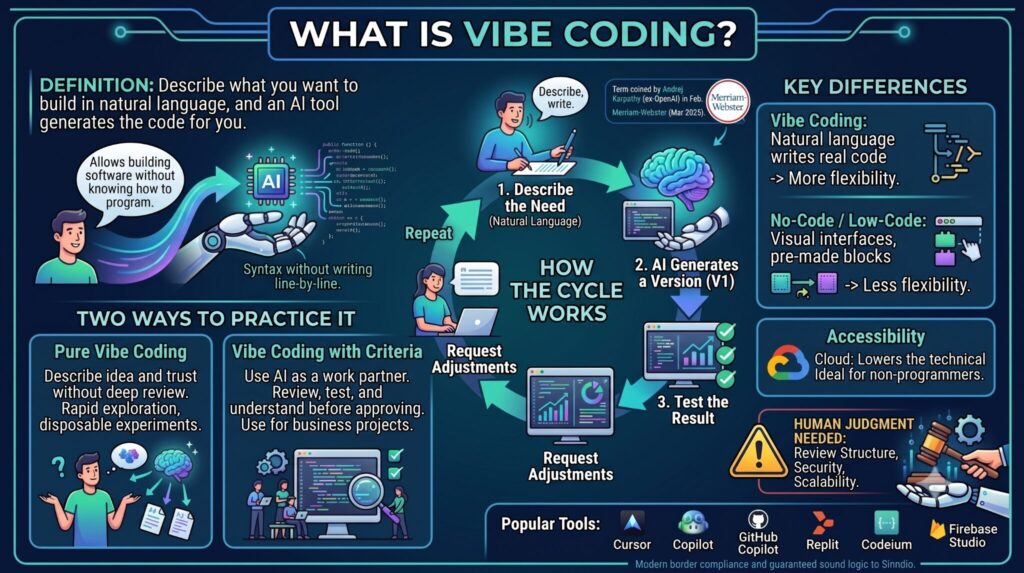
Vibe coding is a way of working in which you describe what you want to build in natural language and an AI tool generates the code for you. The term was coined by Andrej Karpathy, co-founder of OpenAI and former head of the AI team at Tesla, in February 2025.
A month later it was already in the Merriam-Webster dictionary as a slang and trending word, a sign of how quickly it took hold. Since then, it has become the fastest way to name something more and more people were already doing: building software without writing syntax line by line.
It works in cycles. You describe what you need, the AI generates a first version, you test it, request specific adjustments, and repeat the process until the result works for you. Tools like Cursor, GitHub Copilot, Replit, Codeium, and Firebase Studio were the ones that popularized this workflow, although any code-oriented AI assistant can be used in a similar way.
There’s a line that marks where the concept begins and ends. Simon Willison, programmer and co-creator of the Django framework, and today one of the most consulted voices on AI applied to programming, draws the boundary with a simple criterion: the understanding you maintain of the generated code is what defines whether you’re doing vibe coding or simply using AI as a writing assistant. It’s worth distinguishing two ways of practicing it.
- Pure vibe coding consists of describing the idea to the AI and trusting the result without reviewing it in depth, something that makes sense for exploring an idea or putting together a disposable experiment.
- Vibe coding with judgment adds review: you use AI as a work partner, but you review, test, and understand what it generated before signing off on it.
In this article we focus on the second one, which is the one with real application in a business project.
Compared to other alternatives, vibe coding occupies a particular position. No-code and low-code platforms also aim to reduce the need to program, but they do so with visual interfaces and pre-built blocks.
Vibe coding doesn’t depend on those blocks. You describe in natural language and the AI writes real code behind the scenes, which provides more flexibility in exchange for requiring more judgment to review it.
Google Cloud frames it in terms of accessibility: a way to lower the technical barrier to building applications, designed especially for those without a background in programming. Lowering the barrier to entry doesn’t mean eliminating judgment: reviewing the code’s structure, security, and scalability is still human work.
If you’re interested in better understanding what’s behind these language models, we have an article on SEO for LLMs that explains the concept in more detail.
What is vibe coding for?
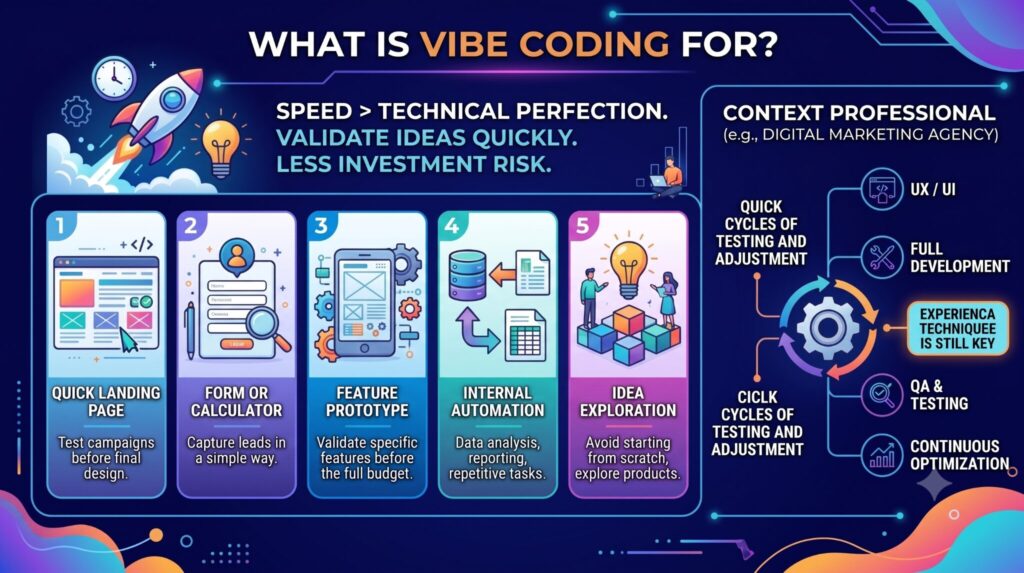
Vibe coding makes sense when speed matters more than technical perfection. Its natural place is validating an idea before investing in full development.
Some concrete uses we’ve been seeing in digital projects:
- Creating an initial landing page to test a campaign before defining the final design.
- Building a form or a simple calculator to capture leads.
- Prototyping a specific feature before assigning it a development budget.
- Automating internal data analysis or reporting tasks.
- Exploring a product idea without starting from scratch.
At a digital marketing agency, vibe coding is useful for testing hypotheses faster, within a professional process that still requires UX, development, QA, and continuous optimization. The cases circulating today show rapid cycles of testing and adjustment, with technical expertise still at the center of the equation.
Advantages and limits of programming with AI
Speed is the most obvious advantage. What used to take days of configuration can now be resolved in an afternoon. It also lowers the barrier to entry: someone without technical training can get to a functional prototype simply by describing what they need.
The limit appears when that prototype goes into production without review. A data point from Y Combinator, one of the most important startup accelerators in Silicon Valley, helps put the phenomenon into perspective: according to Jared Friedman, one of its partners, a quarter of the startups in its early 2025 cohort had 95% of their code generated by AI. The relevant detail is that these were technically capable teams, who used to build everything from scratch and now chose not to.
That’s where the real risk appears. When nobody fully understands the generated code, fixing an error becomes a lottery: changes are tested until the problem disappears, without really understanding why it was happening. In the development community this is called vibe debugging, and it tends to be the gateway to technical debt: code that works today but that nobody can maintain or scale tomorrow.
How to use vibe coding with judgment
The key is to direct the process and review each result step by step. Some practices that help:
- Clearly define what you want to create before writing the first prompt.
- Ask for a simple structure first and iterate piece by piece.
- Test each feature as soon as the AI generates it, not at the end of the process.
- Add a technical review before publishing anything that goes to production.
- Test first in a sandbox environment before touching production.
- Validate the data that enters any generated form or feature, to avoid basic security errors.
- Document the changes, dependencies, and integrations added along the way.
- Reserve vibe coding for prototypes, internal tests, or controlled developments.
- Avoid launching it without QA in projects your business depends on.
Vibe coding applied to digital marketing
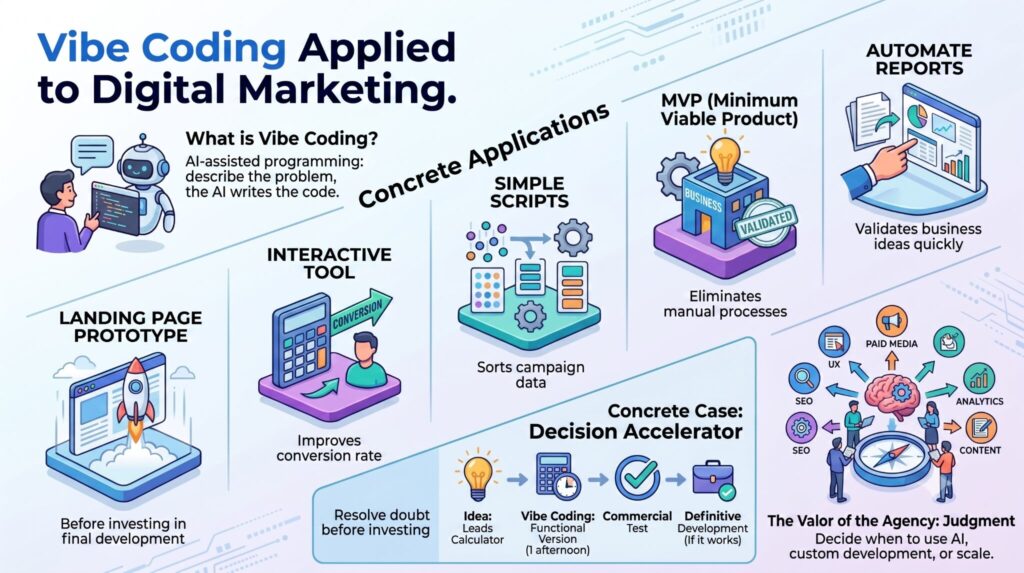
For a digital marketing strategy, vibe coding has concrete applications beyond technical curiosity.
You can prototype a landing page for a performance campaign before investing in the final development. You can create an interactive tool that helps improve the conversion rate of an existing page. It’s also useful for generating simple scripts that organize campaign data, building an MVP that validates a business idea, or automating reports that are currently put together by hand.
Think of it in a concrete case: a marketing team wants to test a budget calculator for a lead campaign before requesting development from the technical team. With vibe coding they can have a functional version in an afternoon and test it with the sales team. If the concept works, then requesting the final development is justified. That’s the kind of decision vibe coding accelerates: clearing up the doubt before investing in something bigger.
These uses work best integrated into a broader strategy that includes SEO, UX, paid media, analytics, and content. That’s where an agency contributes the judgment to decide when it makes sense to solve something with AI, when it’s better to develop it custom, and when it’s time to scale a solution.
Frequently asked questions about vibe coding
How much does vibe coding cost?
It depends on the tool. Most offer a free tier with usage limits and paid plans that scale according to the volume of code generated or usage time. For a simple prototype, the free version is generally enough before evaluating a subscription.
Is it safe to share campaign or client data when using vibe coding?
Each tool’s privacy policy defines what happens with that data. If you’re going to work with sensitive information, it’s worth reviewing it before using the platform for that project.
How long does it take to build something with vibe coding?
For a simple prototype, like a form or a calculator, it’s common to have a first version working within hours. Polishing it and adding technical review before publishing can take longer, depending on how critical the project is.
Conclusions
Professional judgment is an unquestionable requirement. Vibe coding simply accelerates the part of turning an idea into something tangible, but it leaves intact the need to review, test, and decide what to do with it.
If you’re evaluating how to add artificial intelligence, automation, or digital development to your marketing strategy, contact us and let’s see what makes sense for your business.
- Vibe coding: improvising with AI or a new way to program? - August 3, 2026
- Domain with www or without www: which is better for SEO? - June 22, 2026
- 301 redirect: what is it and why is it key in SEO? - April 23, 2026
¿Qué te pareció este artículo?
What do you think about this post?