

Read AI summary
There’s a site ranking above yours for the searches that matter most to you, and you’ve probably wondered more than once what it’s doing right that you haven’t yet. That question has an answer, and it’s called a competitor SEO analysis.
Conducting this analysis allows you to understand which sites are gaining organic visibility, with what keywords, what type of content they’re working with, and what your own site is leaving on the table. The goal is to identify patterns, content gaps, and real opportunities you can leverage to improve your rankings — because simply copying what another site does won’t get you very far.

What Is a Competitor SEO Analysis?
A competitor SEO analysis is the process of studying the sites that compete with yours for the same keywords on Google. Several layers come into play here: the content they publish, the authority they have, how their web architecture is organized, what backlinks they’ve acquired, and what their overall organic performance looks like.
Your commercial competitors and your SEO competitors are not always the same, and that difference tends to cause confusion. You might have a business competitor that doesn’t invest in content and doesn’t appear in the results that matter to you, while at the same time coming across a large blog that doesn’t sell the same thing you do, but has taken the spot in Google you were aiming for.
If you want to go deeper into which practices are best avoided when competing for rankings, we recommend reviewing our article on black hat SEO, because taking shortcuts based on what you see on other sites can be costly.
👉 Want to know what programmatic SEO is and how it helps scale your site? Find out in our latest blog post.
Why Should You Analyze Your SEO Competitors?
Looking at what your competitors are doing gives you something you rarely have when working solely with your own site: context. It allows you to identify keywords you’re not yet targeting, understand what content formats work in your industry, and discover where your site falls short compared to what’s already ranking.
It also helps you make decisions based on real information rather than intuition. If you know your competitors are driving traffic with a certain type of article, or that their link profile is much stronger than yours, you can prioritize your efforts accordingly instead of moving forward blindly.
How to do a Competitor SEO Analysis Step by Step?
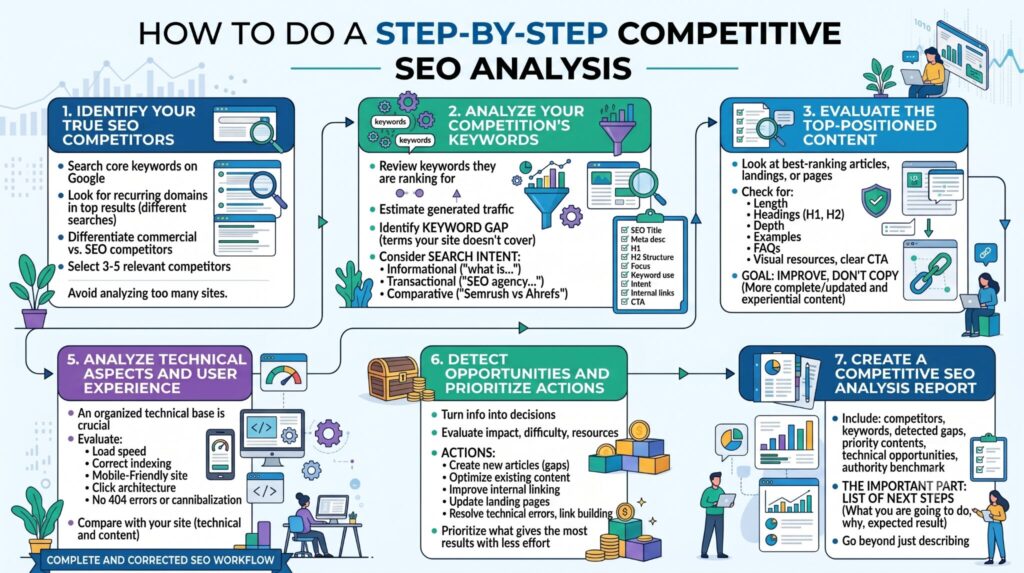
Step 1: Identify Your True SEO Competitors
The starting point is to search Google for your business’s main keywords and pay attention to which domains appear repeatedly in the top results. It’s not enough to note the first result from a single search: what you’re looking for is to identify which sites come up again and again when you try different variations of your most relevant terms.
Your commercial competitors and your SEO competitors don’t always overlap, so it’s worth reviewing the list with that distinction in mind. To keep the analysis manageable, it’s advisable to select between 3 and 5 relevant competitors. If you try to analyze ten sites at once, it’s unlikely the work will ever translate into concrete actions.
Step 2: Analyze Your Competitors’ Keywords
Once you have your list of competitors, the next step is to review which keywords they’re ranking for, which ones are generating the most estimated traffic for them, and most importantly, which terms your own site isn’t yet targeting. This is known as a keyword gap.
Keep in mind the search intent behind each term. An informational keyword like “what is technical SEO” is not the same as a transactional one like “SEO agency Buenos Aires,” or a comparative one like “Semrush vs Ahrefs.” If your competitors are covering funnel stages you’re not touching, that’s a concrete opportunity right there.
If you need to review how to choose and organize your own keywords before making comparisons, our article on the role of keywords in a digital marketing strategy may be helpful.
Step 3: Evaluate the Best-Ranking Content
With the keywords identified, look at your competitors’ articles, landing pages, or pages that rank best for those terms. Pay attention to the length, how they organize their headings, how deeply they cover the topic, and whether they include examples, frequently asked questions, visual resources, and a clear CTA.
The goal is to identify what can be improved: content that is more complete, more up to date, or more closely aligned with your customer’s real experience. Often the opportunity lies in writing something better on the same topic, not necessarily something different.
What to Look for in Each Piece of Competitor Content?
To keep this review from going on forever, it’s worth having a brief checklist for each piece of content you analyze: SEO title, meta description, H1, H2 structure, general approach, keyword usage, how well it addresses the search intent, internal links it uses, and clarity of the CTA. This review has one single objective: to make your next piece of content better than the one you’re analyzing, not a copy in different words.
Step 4: Review Authority, Backlinks, and Internal Links
Backlinks remain an important signal for understanding why a competitor may be ranking better than you, even with similar content. Tools like Semrush, Ahrefs, SE Ranking, or Screaming Frog allow you to see where those links are coming from, how frequently they acquire them, and what type of domains are linking to them.
It’s also worth looking at how they internally link their most strategic pages. If a competitor concentrates internal links toward certain articles or landing pages, it’s quite likely that those pages are part of their conversion strategy, and that gives you a clue as to where they’re focusing their efforts.
Step 5: Analyze Technical Aspects and User Experience
A competitor doesn’t always win because they have better content. Often they win because they have a more solid technical foundation: load speed, correct indexation, a mobile-friendly site, a reasonable click architecture, no stray 404 errors, and no cannibalization between pages competing for the same keyword.
Comparing these aspects with your own site helps you understand whether your problem is one of content, technical issues, or both. If you’ve never done a technical audit of your site, we recommend starting there before moving forward, and for that you can review our step-by-step SEO guide.
Step 6: Identify Opportunities and Prioritize Actions
With all this information gathered, the next step is to turn it into decisions. For each opportunity you identified, think about what impact it could have, how difficult it is to implement, and what resources you’ll need.
This can translate into creating new articles for keywords you’re not yet covering, optimizing existing content that is close to ranking better, improving your internal linking, updating landing pages that have become outdated, resolving specific technical errors, or working on your domain authority through link building. Not everything carries the same urgency, and it’s perfectly fine to start with what gives you the most results with the least effort.
Step 7: Put Together a Competitive SEO Analysis Report
To keep all this work from ending up scattered, it’s worth compiling it into a report that includes the competitors you analyzed, the main keywords in play, the gaps you identified, the priority content to create or improve, the technical opportunities found, and an authority benchmark against your own site.
A report of this kind only has value if it goes beyond describing what you found. The part that really matters is the list of next steps: what you’re going to do first, why, and what result you expect from each action.
Frequently Asked Questions About Competitor SEO Analysis
How Often Should You Repeat a Competitor SEO Analysis?
It depends on the industry. In highly dynamic sectors, such as ecommerce or financial services, it’s advisable to revisit it every three to four months. In more stable or local businesses, doing it once or twice a year is enough, unless you notice significant shifts in your rankings.
What Tools Do I Need to Conduct This Analysis?
You don’t need an expensive subscription to get started. Google and Google Search Console give you valuable information about your own keywords and those of your direct competitors. If you want to go deeper into backlinks, domain authority, or keyword gaps, tools like Semrush, Ahrefs, SE Ranking, or Screaming Frog will save you time, though several offer free or trial versions that are already useful for an initial diagnosis.
How Many Competitors Should I Analyze?
3 to 5 is enough to draw actionable conclusions. If you add more, the analysis becomes difficult to manage and ends up not translating into concrete decisions.
Are My Commercial Competitors and My SEO Competitors Always the Same?
Not necessarily. You may have business competitors that don’t invest in content and don’t appear in the results that matter to you, while at the same time there are sites that don’t even sell what you sell, but occupy the spot you want on Google for certain searches.
What Do I Do With the Information Once I Finish the Analysis?
Turn it into a prioritized action plan. Without that step, the analysis remains just another document, and the idea is for it to serve to adjust your content strategy, your internal linking, and the technical aspects that may be holding back your rankings.
Turn Your Analysis Into a Strategy That Works
A competitor SEO analysis that ends up saved in a folder serves no one. The value lies in what you do next: adjusting your content strategy, improving your internal linking, resolving technical issues, and above all, stopping competing blindly for the same keywords as everyone else.
If you’ve made it this far and feel you’re lacking the time, tools, or an outside perspective to put this analysis into practice, at MD Marketing Digital we can support you throughout the entire process: from the initial diagnosis to defining the strategy and executing it. If you’d like, let’s talk about where your site stands against your competition today.

- Programmatic SEO: What It Is, How It Works, and When to Implement It - October 2, 2026
- International SEO: How to Rank a Website in Different Countries and Languages? - September 25, 2026
- Crawl budget: what it is and how to optimize the crawling of a website - September 18, 2026
¿Qué te pareció este artículo?
What do you think about this post?