
Read AI summary
As a kid, you played house. As an adult, you sell them. That’s life: we evolve. And the way people begin the search for their new home or investment has evolved too. When you were a kid, it was in the newspaper. Today? They search online.
In Buenos Aires alone, online real estate searches increased by 70% throughout 2024. In other words, digital marketing for real estate agencies is no longer optional.
In this guide, we’ll explore techniques and success stories so you can learn how to do real estate marketing. Discover how to stay relevant in a market that moves at the pace of the web.

What does digital marketing for real estate agencies mean?
Digital marketing encompasses the techniques and strategies used to promote a business online while building a consistent brand image. In other words, it helps you connect with your (potential) future clients, stand out among other options, and expand your brand’s reach through the internet.
For real estate agencies, digital marketing goes beyond handing out flyers or putting up signs. It uses different channels and formats to interact with clients, allowing them to access a virtual experience of your brand.
It also relies on precise metrics and real-time audience segmentation tools. This way, the success of each strategy can be analyzed and adjusted to maximize results.
Although real estate marketing strategies may vary depending on the target audience, they typically combine:
- SEO (Search Engine Optimization)
- Content marketing
- Social media
- Paid online advertising
- Email marketing
- Use of real estate CRMs
- Automation
When applied with an integrated approach, these strategies work together to strengthen your online presence. And this is key. After all, your clients are already searching for real estate agencies online, and you need to make sure they find yours.
So, let’s take a closer look at what each of these strategies involves and how they can help you boost your business.
👉 Want to appear in the top local search results? Read our complete guide on how to optimize Google My Business and find out everything you need to know.
Main strategies for real estate agencies
Digital marketing for real estate agencies encompasses different techniques aimed at increasing your visibility, generating qualified leads, and closing deals quickly.
Generally, a strong campaign that generates contact opportunities and interactions with your potential clients includes:
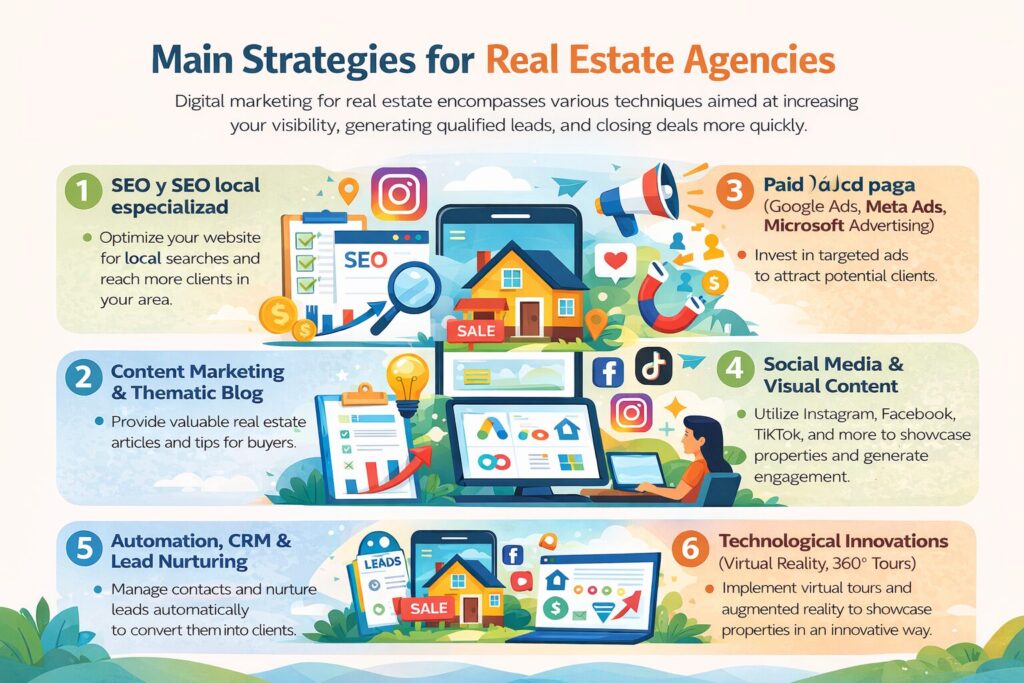
SEO and specialized local SEO
SEO for real estate agencies usually involves optimizing websites, pages, and professional profiles to appear among the top results when people search for properties or agencies in a specific area.
This is known as local SEO. In this type of SEO, websites are optimized to appear in search results within specific locations. Most real estate searches are local, making local SEO a key strategy in real estate marketing.
Local SEO focuses on geolocated keywords, such as “real estate agency in San Juan” or “apartments in Palermo.” Including these keywords in titles, descriptions, URLs, and website content helps search engines determine that your site responds to queries using those terms. In other words, it makes your site more relevant for those searches.
But keywords alone are not enough. Google My Business is a key component of real estate marketing. This tool allows you to optimize a business profile with your agency’s information, property photos, and customer reviews. All of this improves your visibility on Google Maps and builds user trust.
Other aspects SEO works on include site usability, internal linking management, and page loading speed. Together, these factors help make your site more competitive, turning local searches into real opportunities.
Marketing de contenidos & blog temático
Not all users searching for property buying, selling, or renting are ready to become your clients. A key digital marketing strategy for real estate agencies is to create optimized content that attracts organic traffic to your site and answers users’ queries—in other words, content marketing.
Publishing buying guides, market analysis, and home maintenance tips, with up-to-date data and keywords, brings users to your website from search engine results like Google or from AI-powered searches.
Through this marketing strategy, the goal is to persuade users to become leads (contacts) by filling out contact forms, searching for properties, subscribing to events or newsletters, among other actions. The objective is to “nurture” these users from that initial contact in order to turn them into loyal clients.
Paid advertising (Google Ads, Meta Ads, Microsoft Advertising)
Paid advertising campaigns often deliver strong results for real estate marketing. By segmenting your audience based on location, affinity with your site, and using target keywords, you can direct your ads to users interested in your offerings across different channels.
Beyond programmatic advertising, there are three major paid advertising platforms, each with its own advantages, disadvantages, and specific formats:
- Google Ads. You can set up search campaigns (targeted based on user intent), Discovery and Display (to expand your site’s visibility), and Performance Max (your site is promoted across Google’s various channels).
- Meta Ads. It allows you to create highly detailed audience segments based on location, interests, age, and behavior. It is especially effective for visually driven ads.
- Microsoft Advertising. Similar to Google, it supports dynamic search and shopping ads, audience-targeted campaigns, and Performance Max campaigns, with AI tools to improve results.
All these platforms come with tools to measure the success of each campaign and adjust them as needed. They also allow you to launch remarketing campaigns aimed at users who have interacted with your website.
In this way, paid advertising is designed to shorten the sales cycle, bringing potential clients to your site without going through all the stages of conversion. To achieve this, campaigns are focused on meeting specific objectives: lead generation, traffic, or sales.
While the investment can be high, the pay-per-click (PPC) model and audience segmentation—targeting those who are just one click away from completing their next real estate transaction—help optimize spending.
Social media & visual content
Today more than ever, social media is key to real estate advertising. In addition to allowing you to showcase the properties you offer, it helps you interact with potential clients, laying the foundation for a long-term relationship.
The most commonly used platforms in real estate marketing are:
- Instagram. Ideal for sharing photos, reels, and live streams with informative content and images of the properties you market. It offers dynamic formats and supports Meta Ads campaigns.
- Facebook. Similar to Instagram (both owned by Meta) but geared toward a more mature audience. It allows you to create “groups” to share posts and communicate with other users.
- LinkedIn. Essential for building user trust. It’s used to present a corporate image, share company updates, and connect with clients in a professional setting.
- TikTok. When used well, it can exponentially increase your brand’s visibility. It’s commonly used to share short videos showing a real estate agent’s daily life, promote properties, or provide tips to users.
Now, what should you consider to develop a successful social media marketing campaign? Beyond storytelling, following trends, rethinking traditional advertising, or hiring a social media marketing agency to handle it all, some recommended practices include:
- Be consistent with your posts. Planning your content in advance helps maintain posting frequency.
- Interact with your followers. Run giveaways, challenges, or live Q&A sessions to build a more direct relationship with potential clients.
- Maintain a consistent brand image, but adapt it to each platform. Don’t post the same content on LinkedIn as you would on TikTok, Instagram, or Facebook.
- Use high-quality images. Virtual tours help users visualize their future purchase or rental, encouraging lead generation.
- Optimize your posts with hashtags, descriptions, and alt text with specific keywords to help them rank for certain searches.
- Analyze metrics from your posts to identify which formats generate the most engagement and conversions.
Automation, CRM, and lead nurturing
Client contact is a key part of real estate marketing… and one of its most challenging aspects. How can you simplify it? By using CRM (Customer Relationship Management) tools to group contacts, segment them, and track each lead.
Modern CRMs integrate automation features that simplify repetitive tasks and improve customer service. They allow you to centralize contact information, set up automated emails and workflows, assign clients, and prioritize leads based on user interest or behavior (lead scoring).
Some CRMs can also integrate with other digital marketing tools to create a seamless experience from the first contact to closing the deal, nurturing each lead along the way. The benefit? More efficient management, with fewer missed opportunities and personalized messages that strengthen your brand image.
Technological innovations (virtual reality, 360° tours)
How many times have you arranged property showings that led nowhere? Nowadays, technology helps you save time and effort, while also attracting new buyers to your properties. How? Through 360° tours, virtual showrooms, and augmented reality tours.
These tools allow you to show properties online in an immersive way, similar to a physical visit. This helps “filter” prospects so that only truly interested users contact you.
These strategies usually require specialized software, so it’s advisable to work with an agency that focuses on them. But the investment is worth it: you can include 360° tour videos on your website, in email marketing campaigns, landing pages, and social media, maximizing their impact.
How to plan your strategy step by step
Every client is different: there is no single digital marketing strategy for real estate agencies that works the same for everyone. And yet, these unique strategies are often developed using a series of common steps:
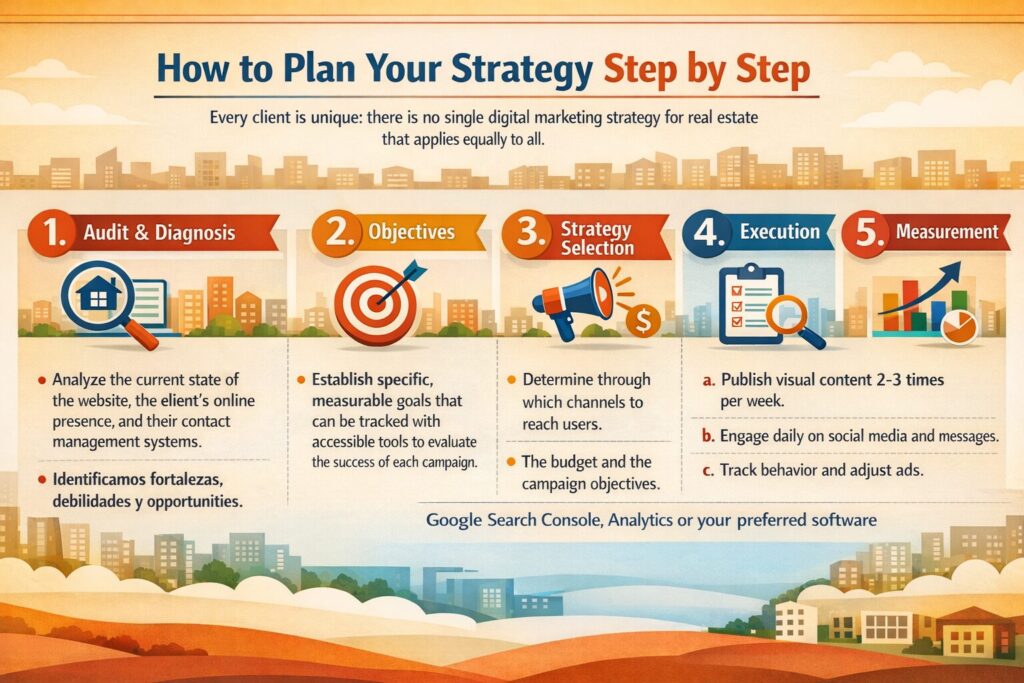
- Audit and diagnosis. We analyze the state of the website, the client’s online presence, and their contact management systems. We identify strengths, weaknesses, and opportunities.
- Goals. We set specific objectives that can be measured with available tools to evaluate the success of each campaign.
- Strategy selection. We determine which channels to use to reach users and which strategies are best suited for this. The campaign’s budget and objectives are also key factors in choosing one strategy over another.
- Execution. We create a schedule of tasks and posts to move forward in an organized way, following best practices for each strategy and platform. For example:
- Publish visual content on social media 2–3 times per week.
- Interact with users daily, through social media stories and by responding to reviews, comments, LinkedIn messages, and more.
- Track prospect behavior to adjust ad campaigns, optimizing them based on search peaks.
- Measurement. We set dates to monitor key metrics in Google Search Console, Analytics, or your preferred software to determine the success of each strategy. We typically analyze website traffic, social media interactions, number of conversions, and ad CTR.
Having a clear set of steps simplifies the process and allows you to focus on creating optimized campaigns with a solid structure—most importantly, campaigns whose performance can be effectively measured.
Frequently asked questions
Do you have any questions about real estate marketing? Here are some of the inquiries we receive most often. If yours isn’t on the list, write to us in the comments. We’re listening!
What is digital real estate marketing?
Digital marketing for real estate agencies is the set of strategies used to attract, connect with, and convert new clients through online channels. It usually has a local focus and uses advanced techniques to deliver an immersive experience to users.
Learn how to choose a digital marketing agency in our guide.
How much does marketing for real estate agencies cost?
The cost of a marketing campaign for real estate agencies varies depending on the scope, the tools used, and the complexity of the project.
Contact us to receive a free audit and determine the total cost of a campaign tailored to your needs.
Which digital marketing strategies for real estate agencies work best?
The best marketing strategies for real estate agencies typically take an integrated approach. They usually combine local SEO, interactive visual content (such as 360° tours), paid advertising campaigns, and automated lead management for greater efficiency.
Is it better to invest in SEO or paid advertising for real estate agencies?
SEO and paid advertising are complementary, so the ideal approach is to invest in both. However, if your budget is limited, it’s best to decide based on your goals:
- Paid advertising delivers immediate results, but it can be costly to sustain over time.
- SEO generates long-term results and can be maintained with a lower investment.
Looking to boost your campaign results? We’ll tell you all about CRO (Conversion Rate Optimization).
How do you measure the ROI of a real estate strategy?
To measure the return on investment (ROI) of a real estate marketing strategy, you need to determine:
- The revenue generated thanks to that strategy.
- The cost of your investment in that marketing strategy.
Once you have these figures, calculate:
(Revenue – cost) / investment cost x 100
This will tell you your return on investment as a percentage.
Can I do real estate marketing with a low budget?
Yes. There are marketing strategies for real estate agencies—such as local SEO, social media content creation, and email marketing campaigns—that are budget-friendly.
Looking to maximize your marketing investments? Learn how to do SEO step by step.
Your online presence, turnkey
Digital marketing for real estate agencies is no longer optional—at least not if you want your business to grow. The good news? It’s far from limiting: there are many channels to reach your clients, and even more marketing strategies to explore.
Combining the best practices of local SEO, content marketing, paid advertising, and innovative formats like virtual reality tours in a single campaign boosts your online presence and strengthens your professional image, helping you reach new clients.
The key to success? Integrating your marketing activities strategically. An optimized website, targeted campaigns, and an active presence on social media generate sustainable, measurable results—and efficient ones, if you support these strategies with a CRM and automated workflows.How can you achieve this? Simple: with MD Marketing Digital. Discover how real estate marketing can boost your conversions and strengthen your brand. Contact us to receive a free diagnosis or request a quote tailored to your needs.

- WooCommerce vs PrestaShop: Which One Should You Choose in 2026? - July 24, 2026
- Real estate marketing: strategic guide - March 19, 2026
- GEO vs SEO: what they are and how they differ - January 19, 2026
¿Qué te pareció este artículo?
What do you think about this post?